Filters

347 filtered results

Clear all filters
Favorites
With answer key
Interactive

347 filtered results

Difficulty Level

Grade


Check out this FREE Trial Lesson for age 3!

What Is Chess?

Favorites
With answer key
Interactive
  • 3
  • Interactive
  • Normal
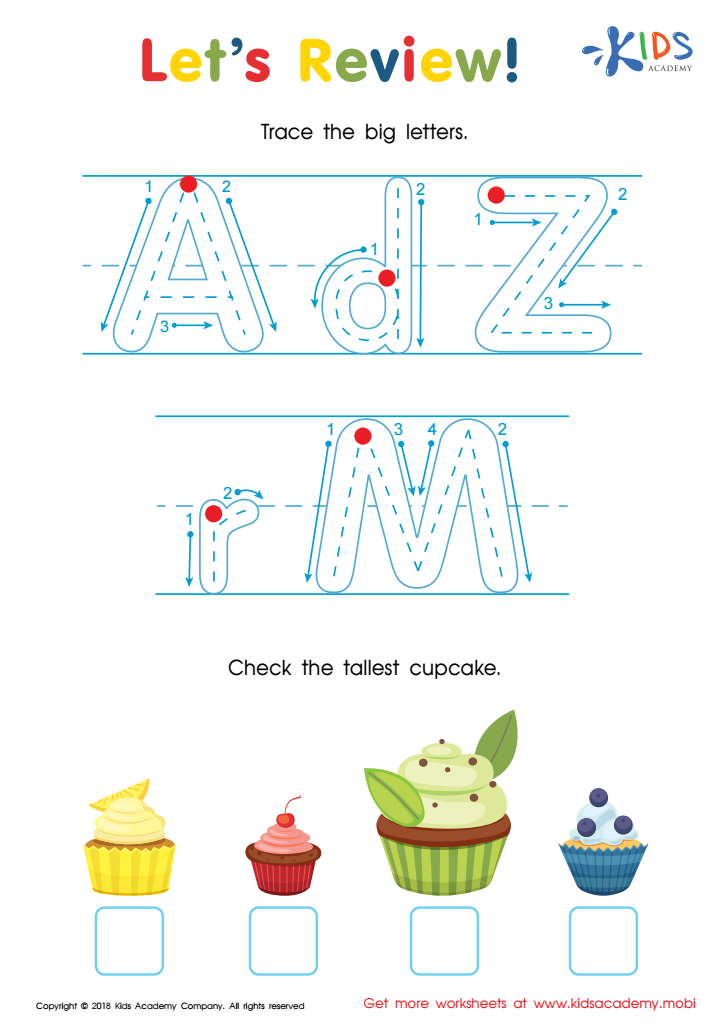
Let's Review! Big Letters Worksheet

Let's Review! Big Letters Worksheet

Teach your child to read and write big and small letters with Kids Academy's tracing worksheet. Show them how to guide their pencil with each stroke. Reinforce their understanding with fun cupcake pictures and help them choose the tallest one. It's a great way to help them differentiate between uppercase and lowercase letters.
Let's Review! Big Letters Worksheet
Worksheet
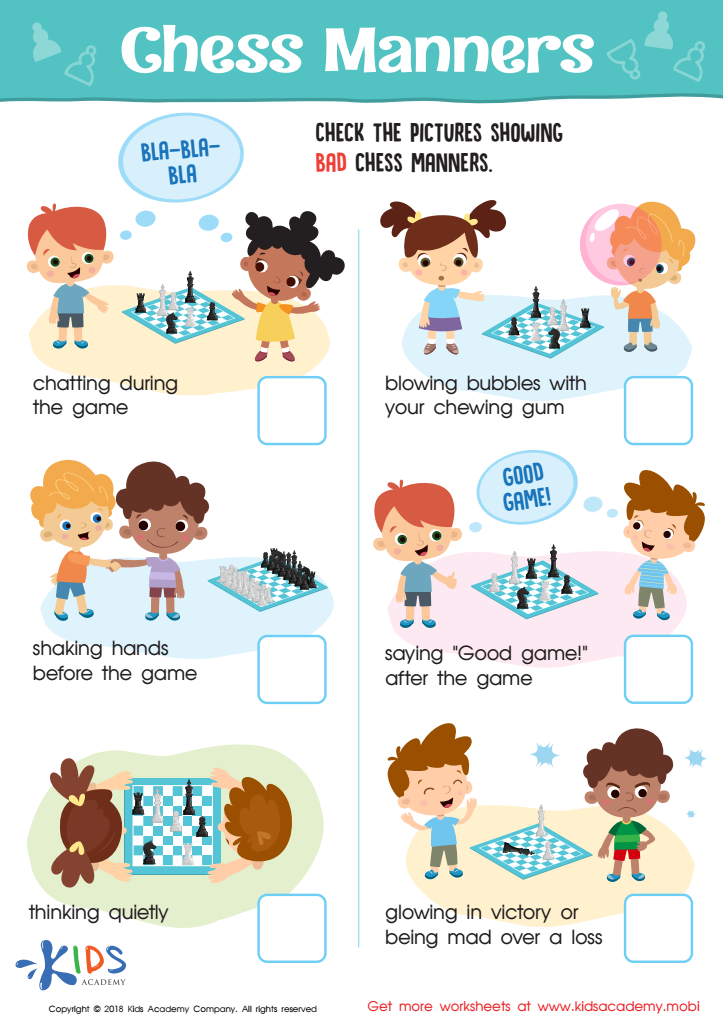
Chess Manners Worksheet

Chess Manners Worksheet

Teach your child chess manners in addition to table and social ones. Chess has clear rules and etiquette which must be followed for a proper game. Review this worksheet with your kid and discuss the pictures that show inappropriate behaviours. This will help them understand how to play the game correctly and with good manners.
Chess Manners Worksheet
Worksheet
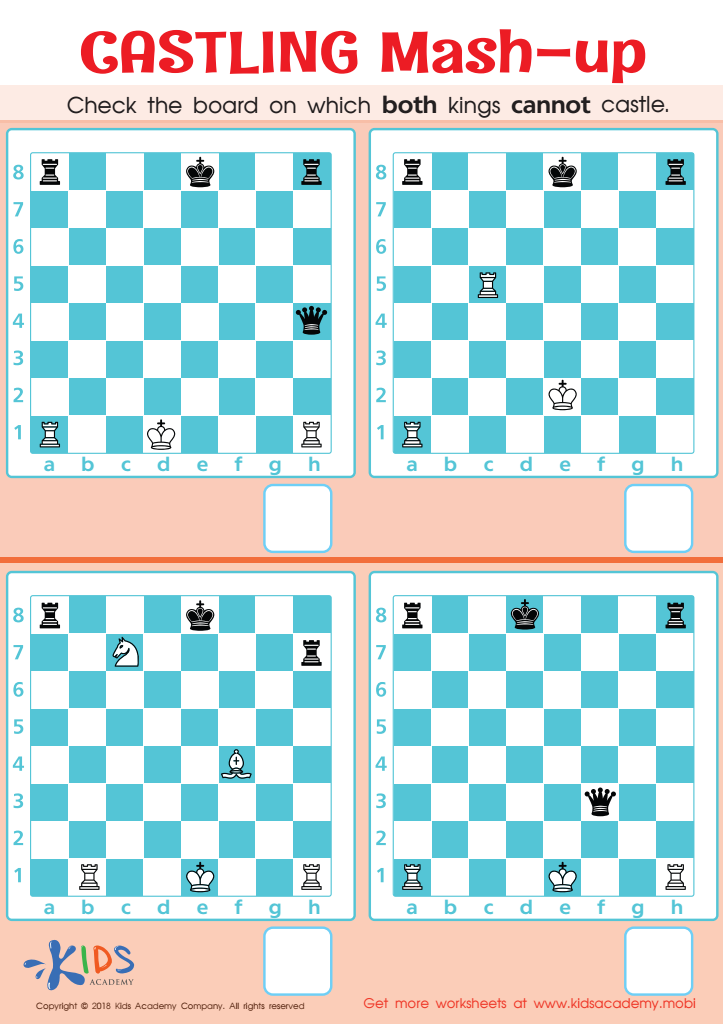
Castling Mash–up Worksheet

Castling Mash–up Worksheet

Before starting the worksheet, ensure your child understands castling in chess. If not, take time to explain it. Once they have a clear grasp of the rules, help them complete the exercise. Check the board to ensure that neither king can castle.
Castling Mash–up Worksheet
Worksheet
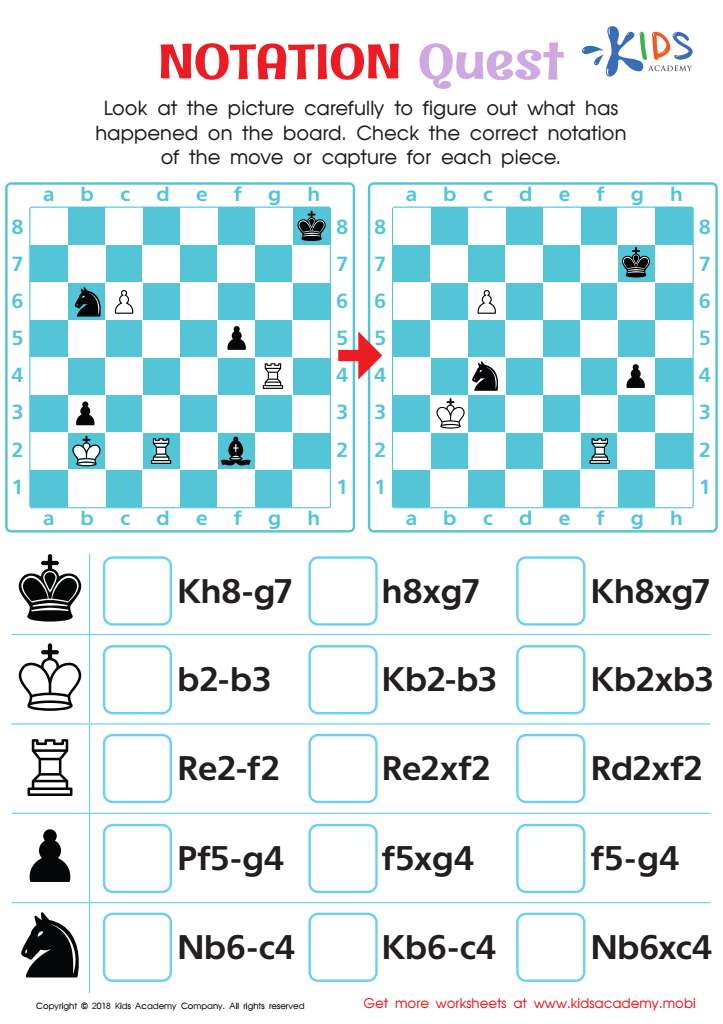
Notation Quest Worksheet

Notation Quest Worksheet

Examine the two chess boards with your kids. On one, chess pieces haven't moved; on the other, pieces have captured each other. Get your child to note the moves and captures with this simple worksheet.
Notation Quest Worksheet
Worksheet
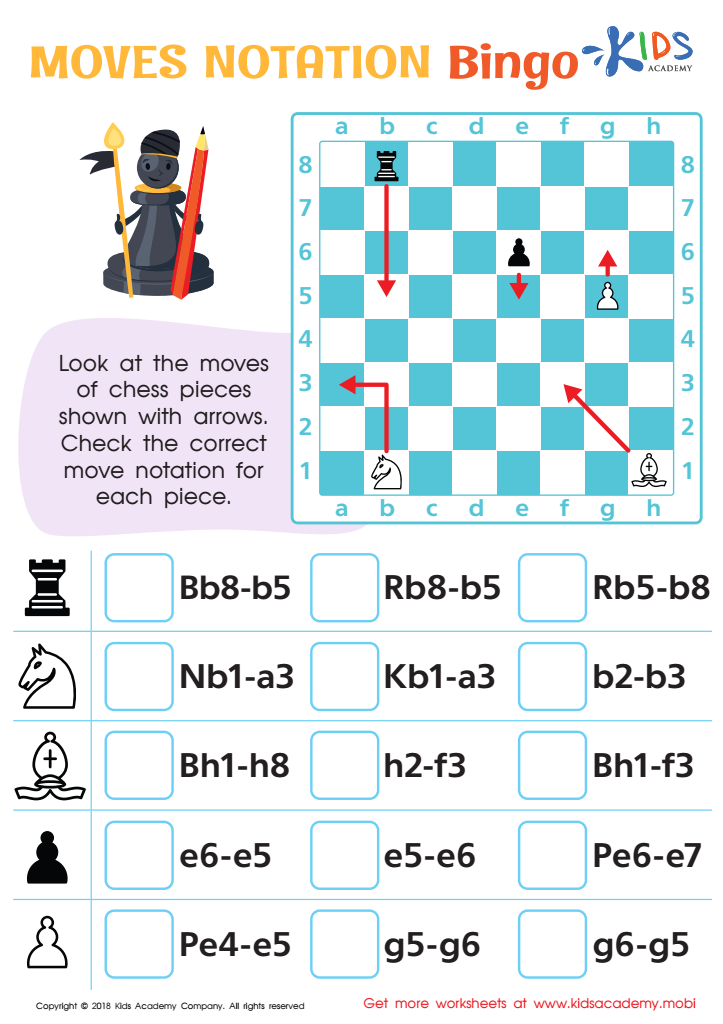
Moves Notation Bingo Worksheet

Moves Notation Bingo Worksheet

Test your child's chess notation skills with this simple worksheet. Download the PDF which shows a chess board and arrows pointing to pieces. Ask your child to identify the moves and note them down correctly. The notations needed are for bishop, pawn, rook and knight. Up to 80 words.
Moves Notation Bingo Worksheet
Worksheet
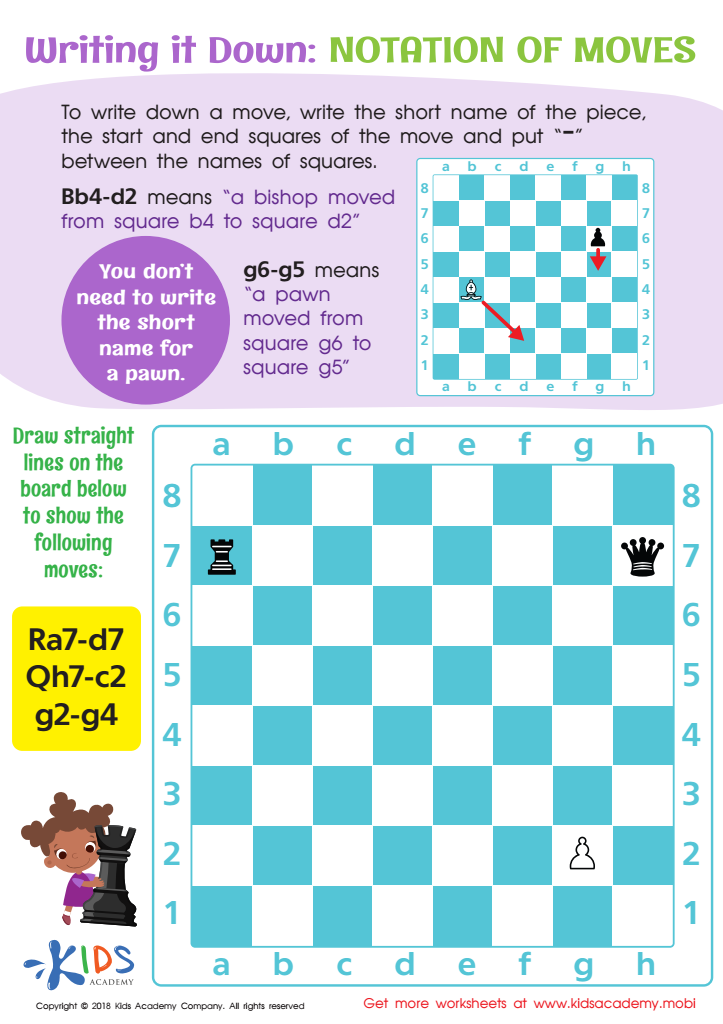
Notation of Moves Writing it Down Worksheet

Notation of Moves Writing it Down Worksheet

Notating chess moves can be tricky for kids to learn. This worksheet will help them better understand it. To notate a move, write the piece's short name, start and end squares, and separate them with a "-". For instance, Bd4-d2 means a bishop moved from b4 to d2. No need to write pawns' short names.
Notation of Moves Writing it Down Worksheet
Worksheet
Notation of Captures Writing it Down Worksheet

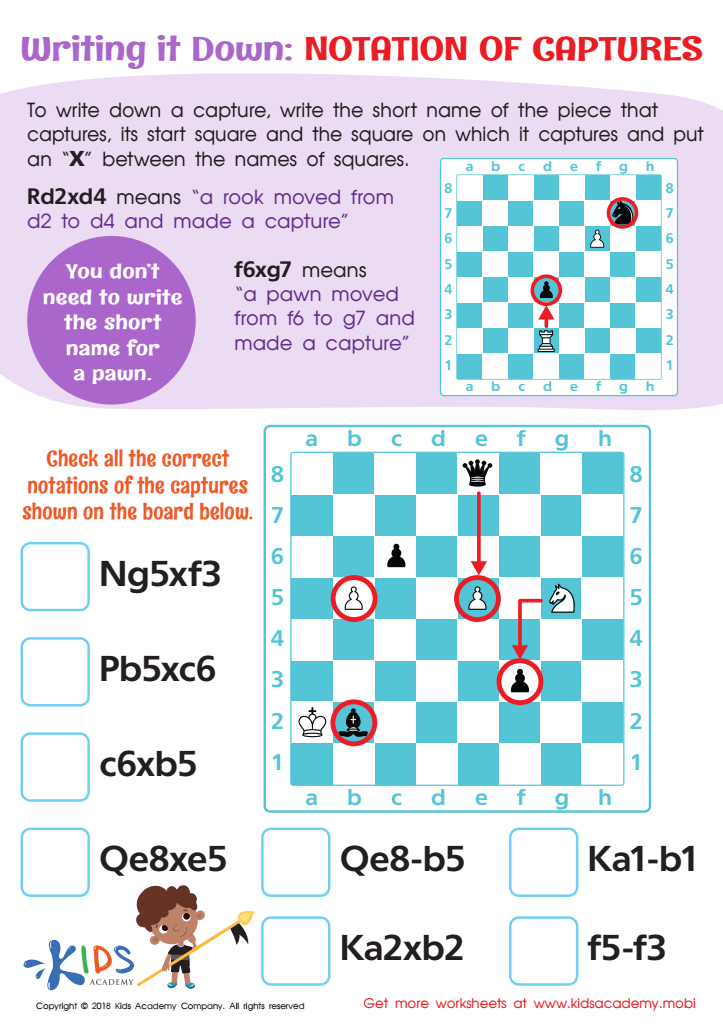
Notation of Captures Writing it Down Worksheet

To teach students how to record captures in chess, use this worksheet. Write down the piece's short name, start sq., and the sq. where it captures, separating them with an X. For example, Rd2Xd4 means a rook moved d2 to d4 and took a piece. Pawn captures don't need a name.
Notation of Captures Writing it Down Worksheet
Worksheet
Chess Pieces Quest Worksheet

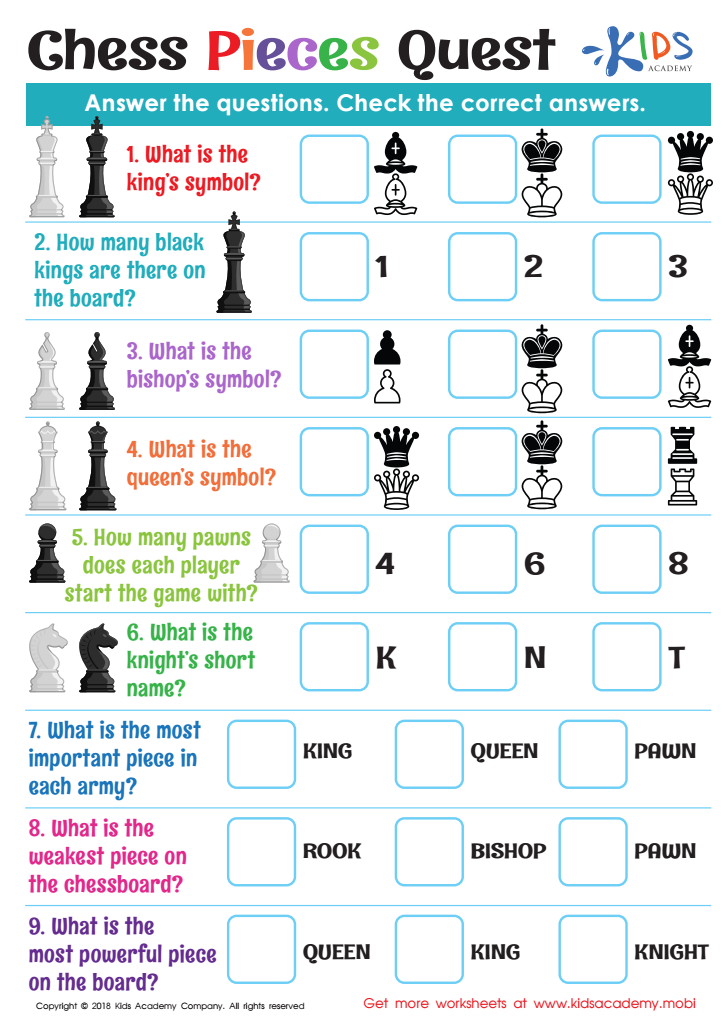
Chess Pieces Quest Worksheet

Help your child prepare for the chess quest by refreshing their knowledge of the symbols and characteristics of each chess piece. Then, have them try the 9 questions on this worksheet. These questions will assess their understanding of the symbols and how many pieces each player starts with.
Chess Pieces Quest Worksheet
Worksheet
What's My Name? Worksheet

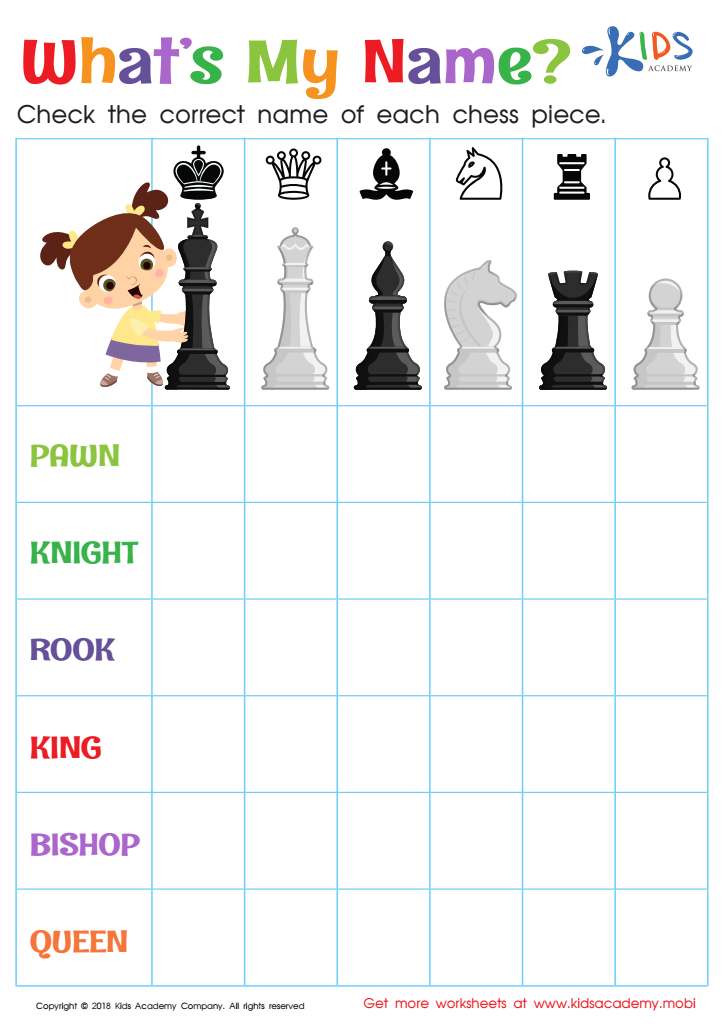
What's My Name? Worksheet

Test your child's chess knowledge with this colorful worksheet! There are six pieces lined up with names underneath. Ask your child to name each piece, then check if it's correct. Help them succeed by brushing up on the different pieces and their names.
What's My Name? Worksheet
Worksheet
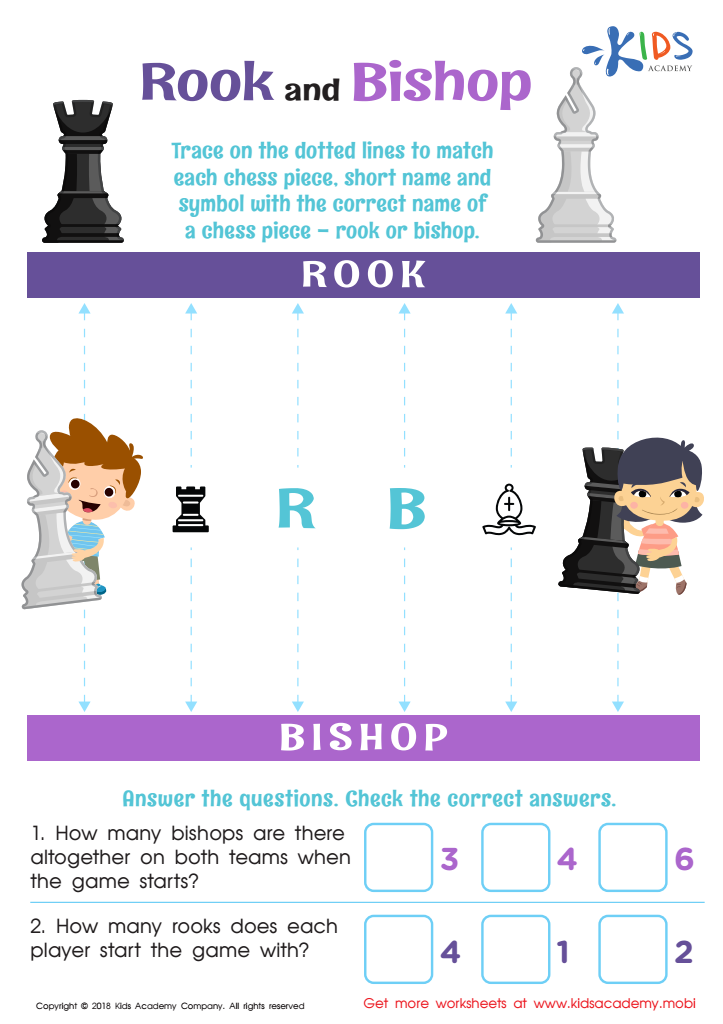
Rook and Bishop Worksheet

Rook and Bishop Worksheet

This tracing sheet helps your child learn chess pieces by matching each piece, short name and symbol to the correct name. After tracing, have them answer the questions and check their answers. It's a great way for them to become familiarized with chess.
Rook and Bishop Worksheet
Worksheet
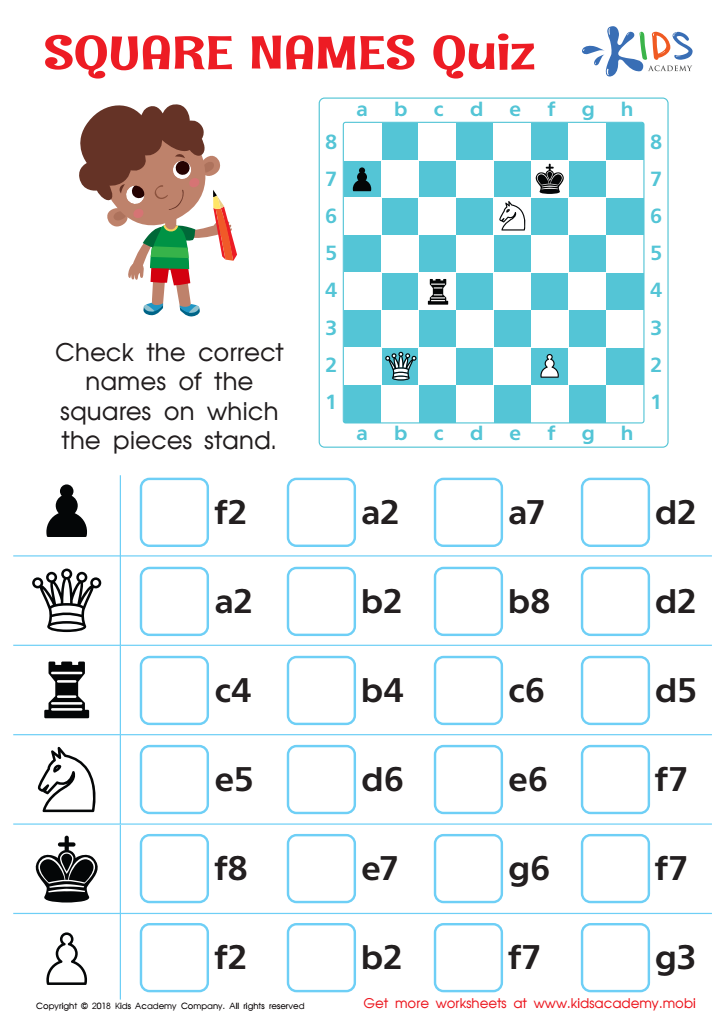
Square Names Quiz Worksheet
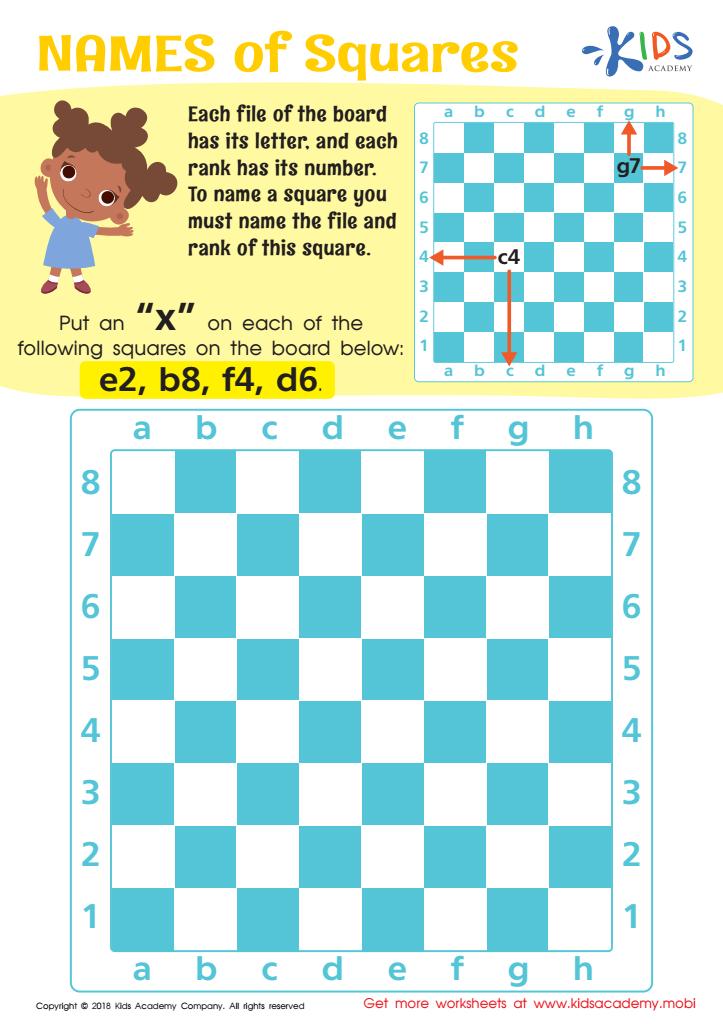

Square Names Quiz Worksheet

Make sure your students can identify the chess squares with ease! This free pdf worksheet will help them learn the names of the squares quickly and easily. Let them check the correct names of each square to prepare them for playing chess and making notations of their moves.
Square Names Quiz Worksheet
Worksheet
Names of Squares Worksheet

Names of Squares Worksheet

Ask your students to put an X on the appropriate squares. This worksheet is part of learning chess basics. Each file is marked with a letter and rank with a number. This allows moves and squares to be easily named and noted. e.g. The square marked "e5" is the fifth rank of the e-file.
Names of Squares Worksheet
Worksheet
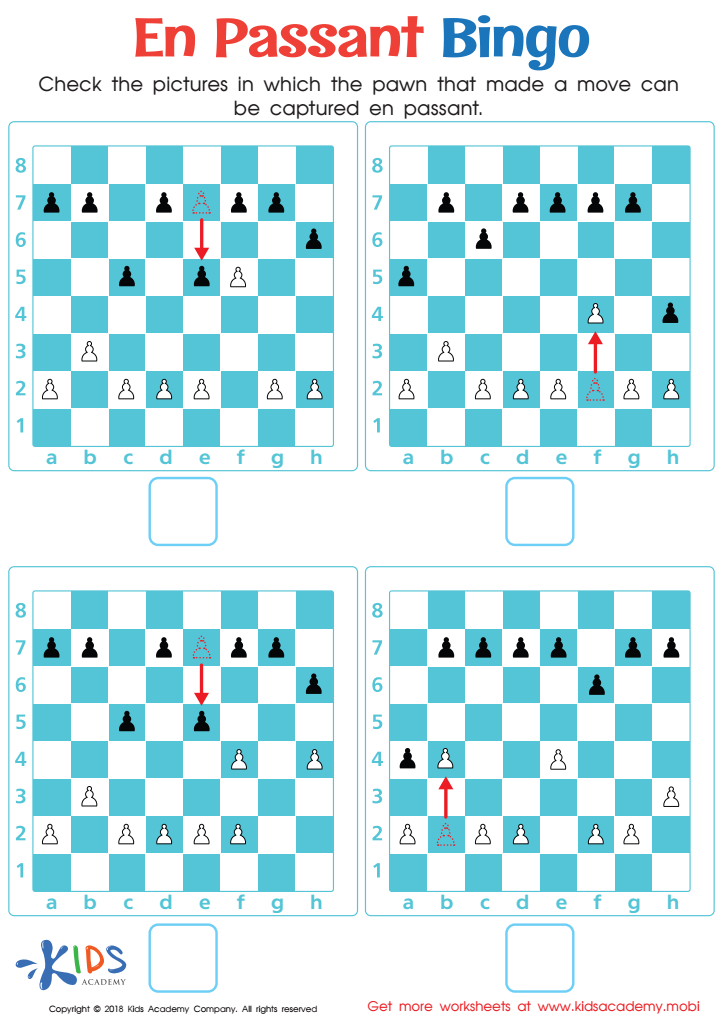
En Passant Bingo Worksheet

En Passant Bingo Worksheet

To teach kids to perfect the en passant move in chess, use this worksheet. It has pictures which depict when a pawn is in danger of being captured. By looking through the pictures, kids can easily understand and perfect the move.
En Passant Bingo Worksheet
Worksheet
Smart Capturing Worksheet

Smart Capturing Worksheet

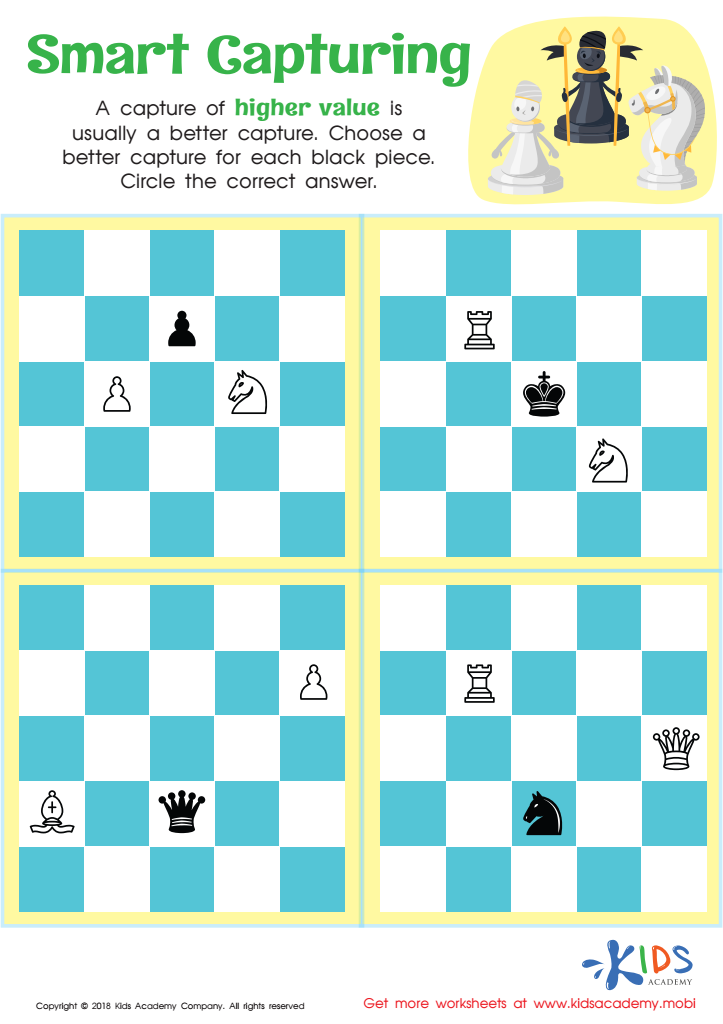
Chess is a game of strategy and calculation. When presented with two captures, a player should always go for the one that yields the highest value. For example, taking a knight over a pawn. In this worksheet, your children will choose the best capture for each black piece. Ask them to circle the correct answers. (80 words)
Smart Capturing Worksheet
Worksheet
Chess Pieces Math Worksheet

Chess Pieces Math Worksheet

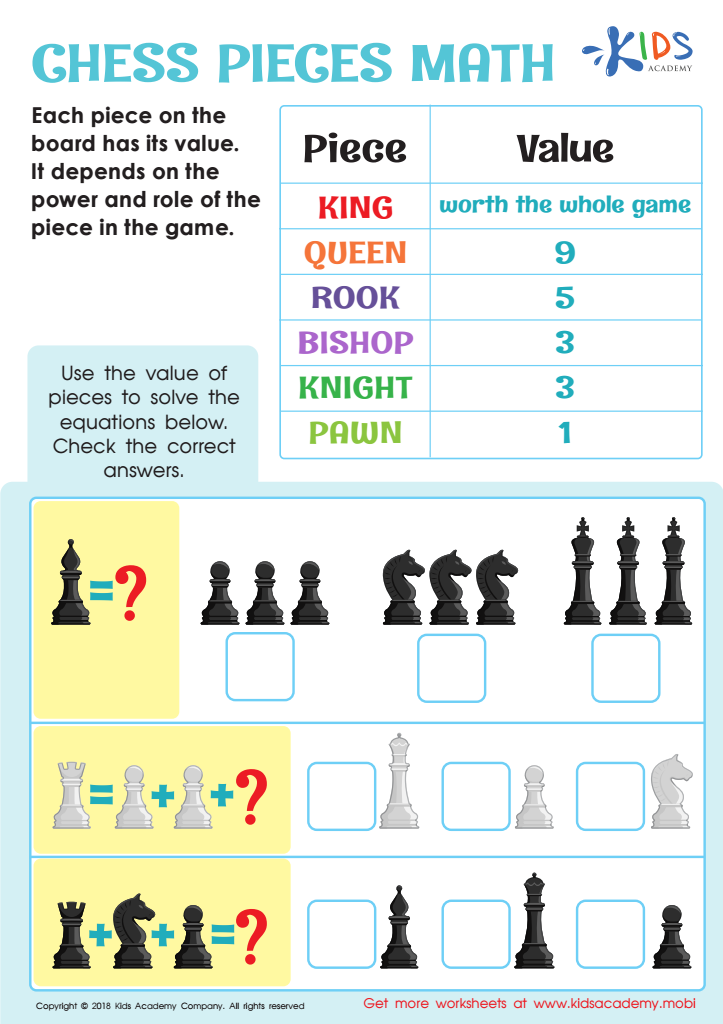
Chess involves math! Each piece has its own value, from the king (worth the entire game) to the queen (9 points), varying according to their power and role. In the worksheet, your child must use these values to solve the equations at the bottom.
Chess Pieces Math Worksheet
Worksheet
Changing Power of Chess Pieces Worksheet

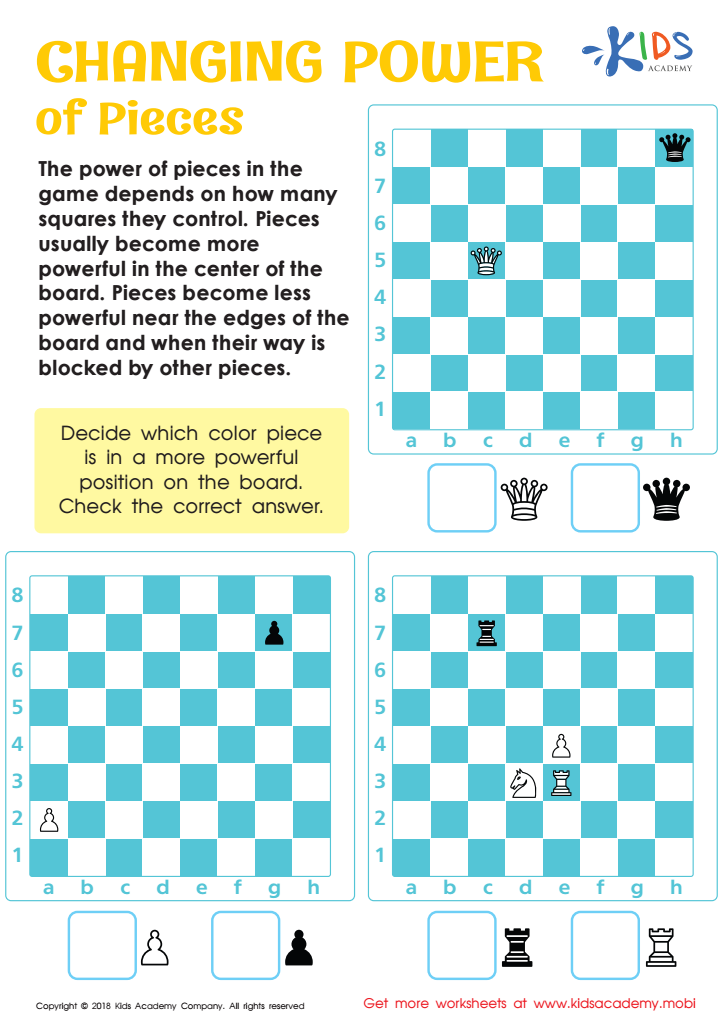
Changing Power of Chess Pieces Worksheet

Chess pieces have different power levels based on their position. When in the middle of the board, they are strongest; at the edges or blocked by other pieces, they are weakest. Help your child learn which pieces are in powerful positions by examining the worksheet.
Changing Power of Chess Pieces Worksheet
Worksheet
Attacking Power of Chess Pieces Worksheet

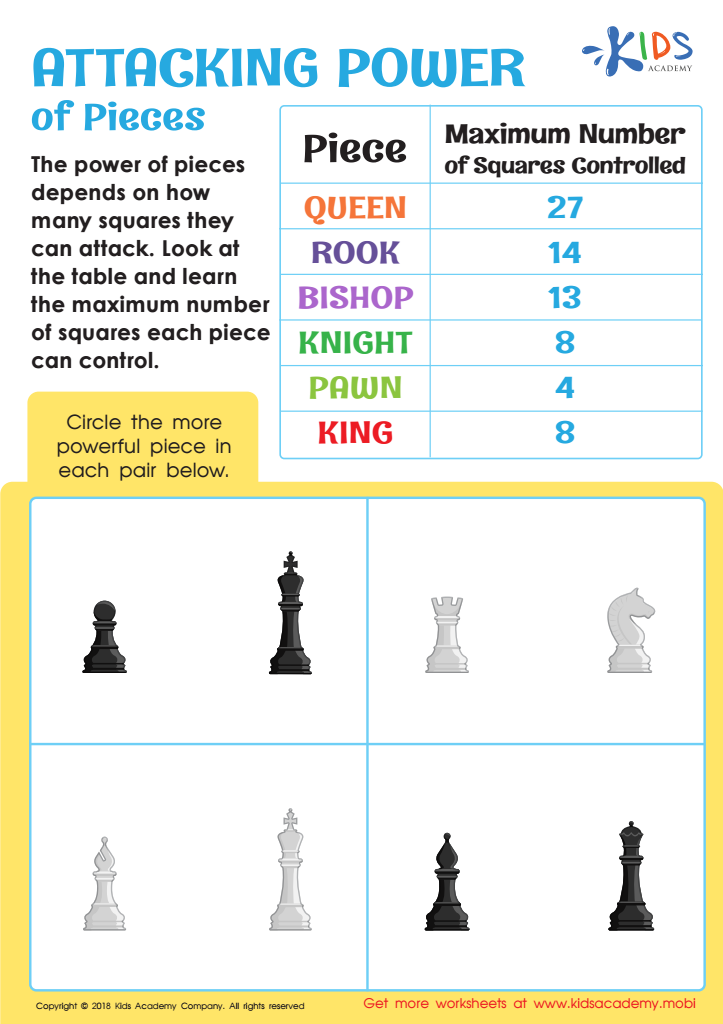
Attacking Power of Chess Pieces Worksheet

. This worksheet introduces your child to chess pieces and how they move. Ask them to look at the table, noting the squares each piece can control. Then, have them circle the most powerful piece among each power pictured at the bottom. With this insight, your child will gain an understanding of a chess piece's power and how many squares it can attack.
Attacking Power of Chess Pieces Worksheet
Worksheet
Writing it Down Worksheet

Writing it Down Worksheet

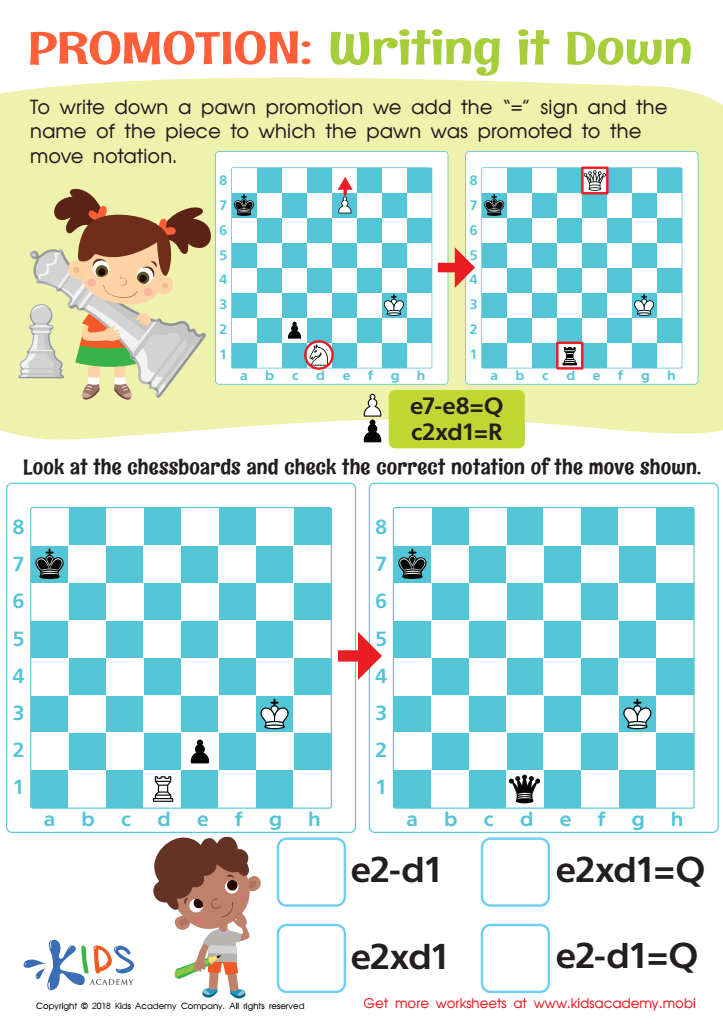
To document pawn promotion, add "=<piece name>" to the move notation. For example: e7-e8=Q. Ask your child to look at the chessboard and take note of the moves. Check the notations are correct. (80 words)
Writing it Down Worksheet
Worksheet
Promotion Practice Worksheet
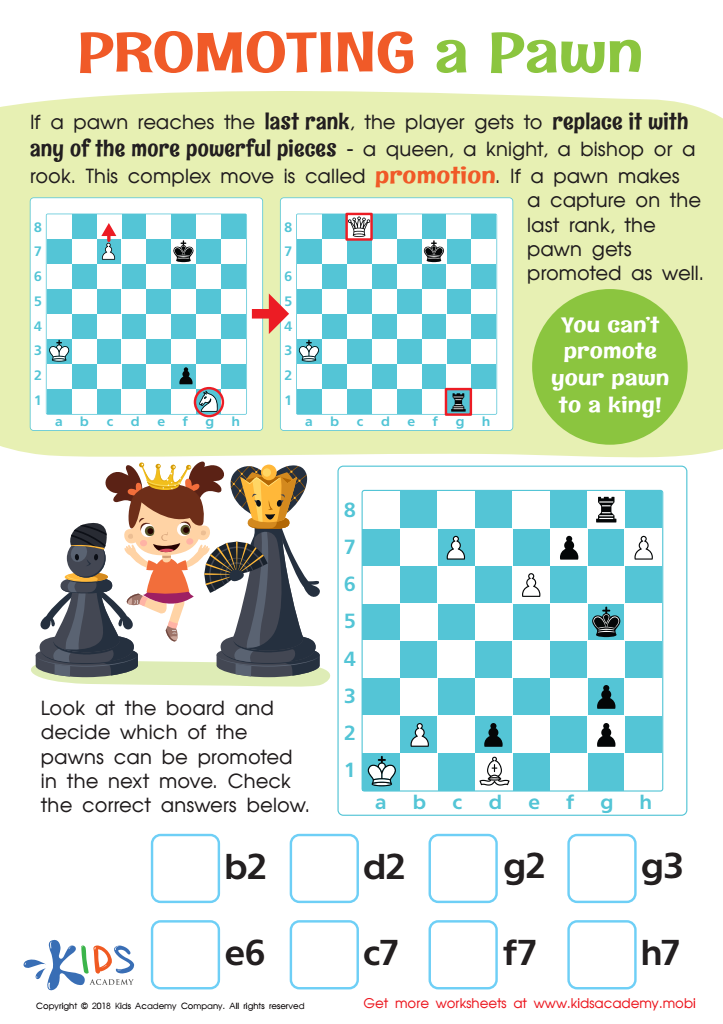

Promotion Practice Worksheet

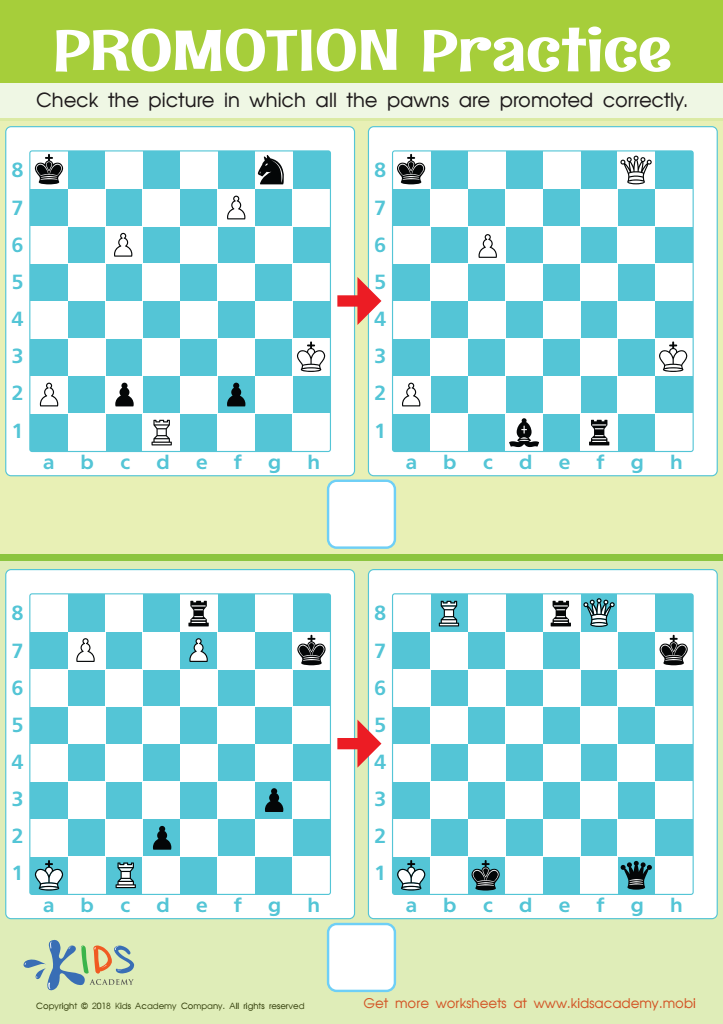
Test your kids' promotions skills with this worksheet! Ask them to find the pictures in which the pawns are correctly promoted. Remember, when a pawn reaches the last rank it may be promoted to a queen, bishop, knight or rook. In addition, a pawn can be promoted when it captures a chess piece on the last rank.
Promotion Practice Worksheet
Worksheet
Promoting a Pawn Worksheet

Promoting a Pawn Worksheet

Teach your kids all about pawns with this fun worksheet! Pawns may seem restricted, but experienced players can guide them across the board. If a pawn reaches the last rank, the player can upgrade it to a more powerful piece (e.g. queen, knight), or promote it if it captures an enemy piece. Give them the tools to master the game!
Promoting a Pawn Worksheet
Worksheet
Knight and Pawn Worksheet
Knight and Pawn Worksheet

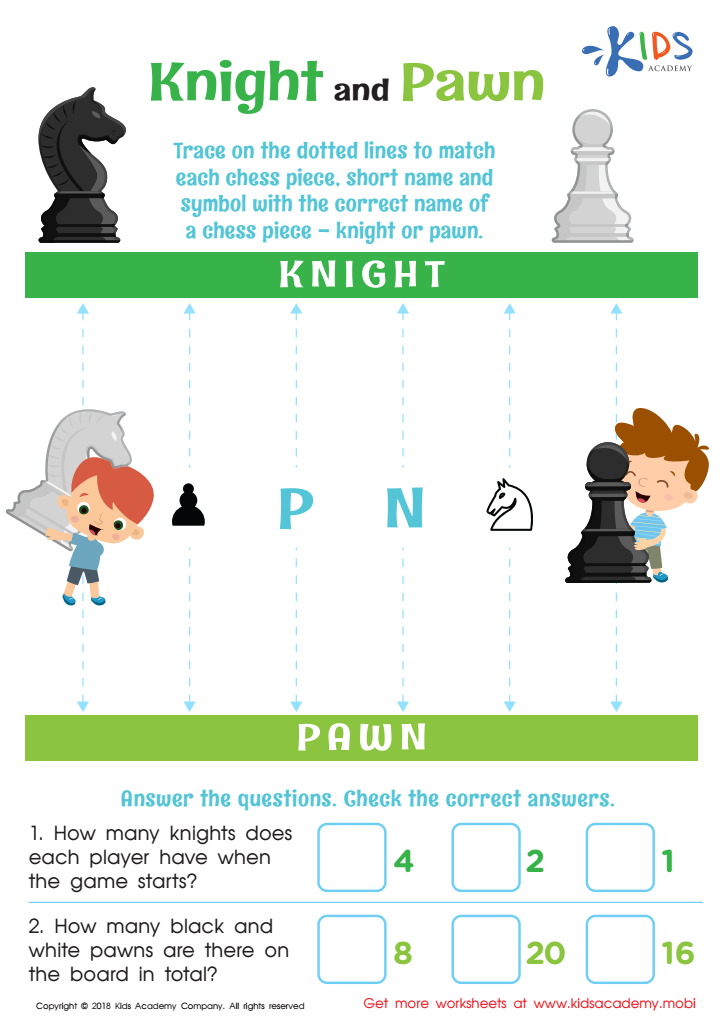
This tracing worksheet teaches kids about chess. They trace the dotted lines to match pieces, names and symbols to the correct chess piece. Questions at the bottom test their understanding. It's a simple exercise for a fun way to learn.
Knight and Pawn Worksheet
Worksheet
King and Queen Worksheet

King and Queen Worksheet

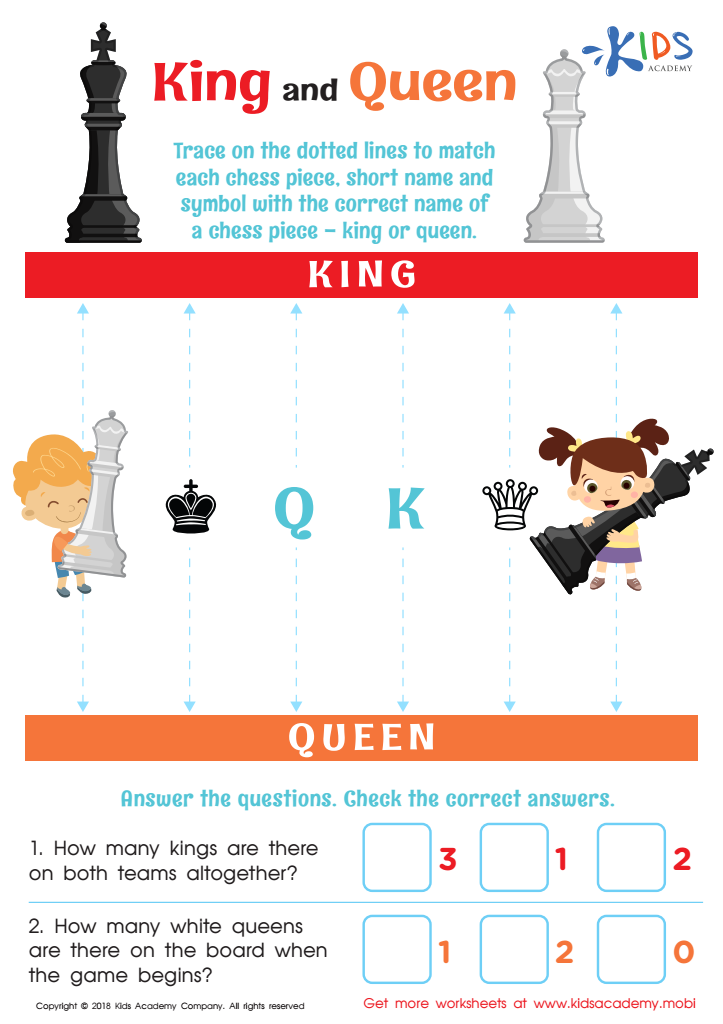
Instruct your kids to trace the dotted lines to match each chess piece, short name, and symbol with either king or queen.Answer the questions at the bottom and check the answers. This exercise will help your children to differentiate between a king and queen chess piece and know their symbols.
King and Queen Worksheet
Worksheet
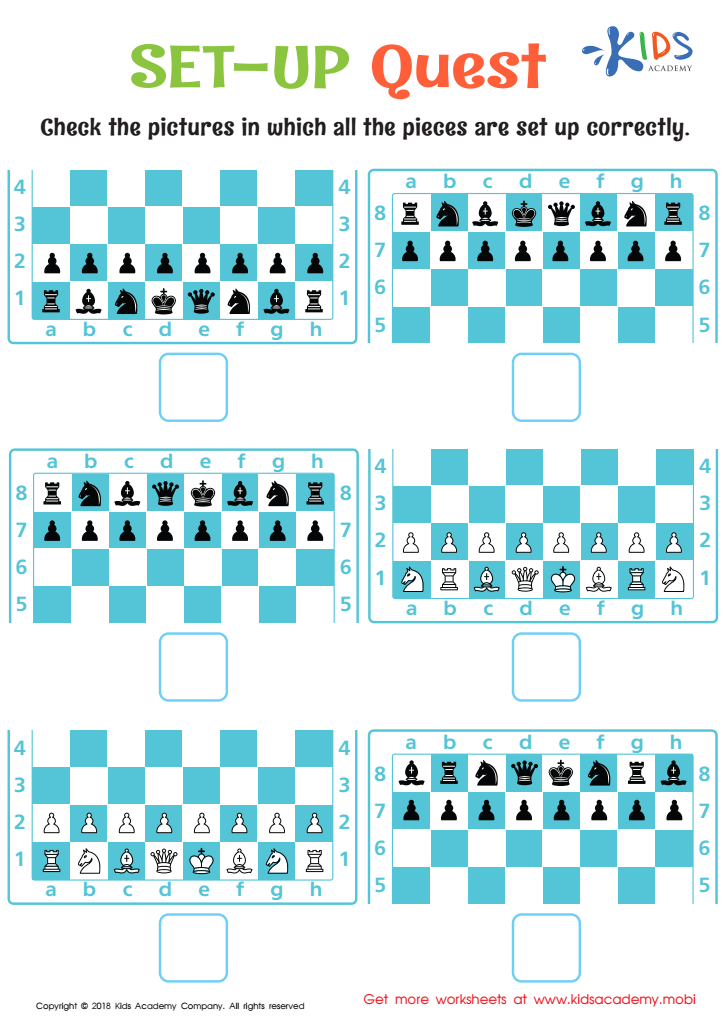
Set-up Quest Worksheet

Set-up Quest Worksheet

Have your students mastered checkmates? However, they may not know the proper way to set up a chessboard. Ask them if they know how and show them images of the correct set-up.
Set-up Quest Worksheet
Worksheet
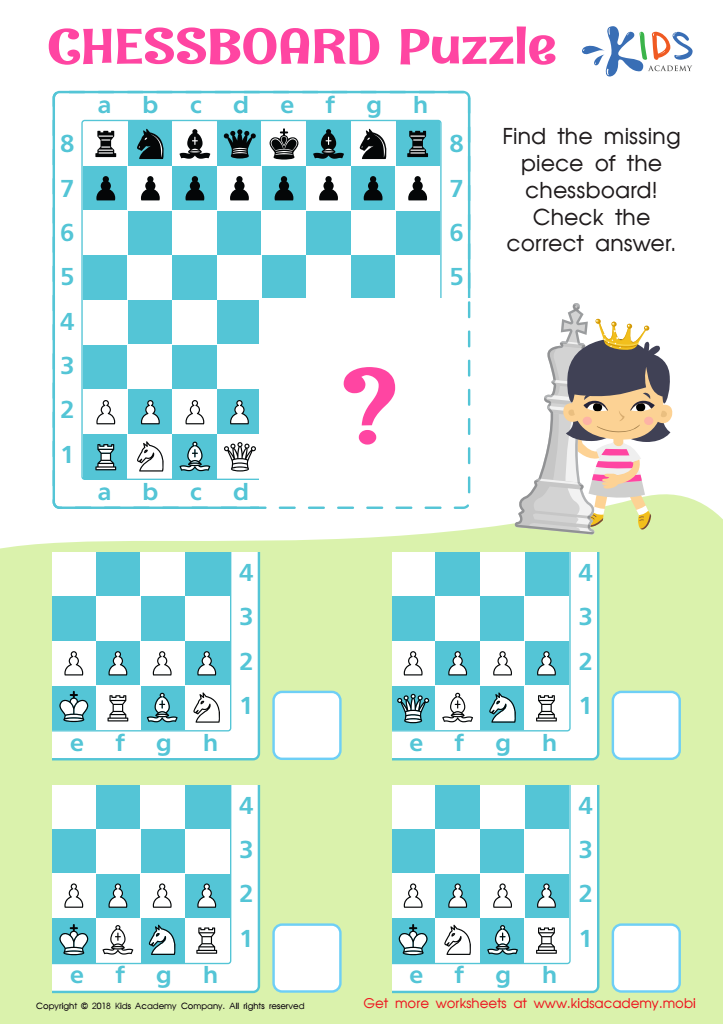
Chessboard Puzzle Worksheet


Chessboard Puzzle Worksheet

Test your child's chess prowess with this simple worksheet. They must find the missing pieces to complete the white side of an empty chessboard. The black pieces are already arranged properly on the board. Correct answers are provided so you can see how they did!
Chessboard Puzzle Worksheet
Worksheet


Normal worksheets tailored specifically for 3-year-olds are an invaluable educational tool, seamlessly blending learning with fun. These worksheets are meticulously designed to align with the developmental milestones of toddlers, making them an ideal resource for nurturing young minds.

Firstly, these worksheets serve as a foundation for basic literacy and numeracy. They introduce 3-year-olds to the world of letters and numbers in an engaging and age-appropriate manner. Through interactive tasks, children begin to recognize shapes, colors, and patterns, all of which are essential skills for their upcoming academic journey.

Moreover, normal worksheets for 3-year-olds are instrumental in enhancing fine motor skills. Activities such as tracing, drawing, and coloring improve hand-eye coordination and prepare children for writing. This hands-on experience is crucial for their physical development and fosters independence.

Additionally, these worksheets encourage critical thinking and problem-solving from a young age. With puzzles and matching games, children learn to analyze situations and think creatively. This not only stimulates their intellect but also boosts their self-confidence as they learn to tackle challenges independently.

In conclusion, normal worksheets for 3-year-olds are more than just paper and pencil activities. They are a holistic approach to early childhood education, designed to cater to the intellectual, physical, and emotional development of toddlers, setting a solid foundation for lifelong learning.