Sorting Worksheets for Ages 5-7 - Page 2
25 filtered results
-
From - To
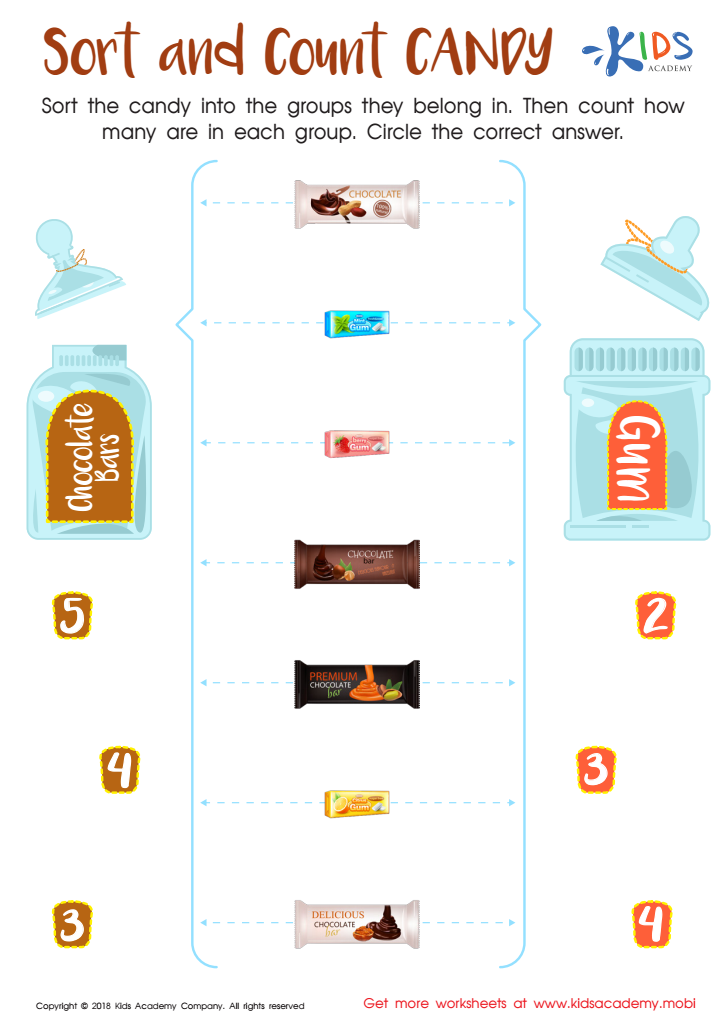
Sort and Count Candy Worksheet
 Assign to My Students








Sorting is a fundamental cognitive skill that lays the groundwork for a child's future academic and life success, making it crucial for parents and teachers of children ages 5-7 to prioritize. At its core, sorting helps children develop their ability to organize information, recognize patterns, and categorize objects based on various attributes such as color, size, shape, or type. These skills are essential for more advanced mathematics and science concepts.
By engaging in sorting activities, children enhance their attention to detail and improve their observational skills. This organizing process fosters critical thinking and problem-solving abilities as children decide how to group different items. Moreover, sorting also promotes the development of language skills. As children articulate their thought processes and explain their sorting criteria, they learn new vocabulary and improve their communication abilities.
Teachers and parents can make sorting learning-playful and effective. Practical activities such as organizing toys, separating laundry by color, or gathering natural objects like leaves and rocks can be both enjoyable and educational.
Encouraging sorting at an early age fosters a love of learning and equips children with a solid foundation in analytical thinking, empowering them to take on more complex educational challenges as they grow. Thus, sorting should not be overlooked as merely a basic skill; it is, in fact, an essential component of early childhood education.








