Filters

901 filtered results

Clear all filters
Favorites
With answer key
Interactive

901 filtered results

Difficulty Level

Grade


Check out this FREE Trial Lesson for age 7!

Special Moves: En Passant

Favorites
With answer key
Interactive
  • 7
  • Interactive
  • Normal
Square Names Quiz Worksheet

Square Names Quiz Worksheet

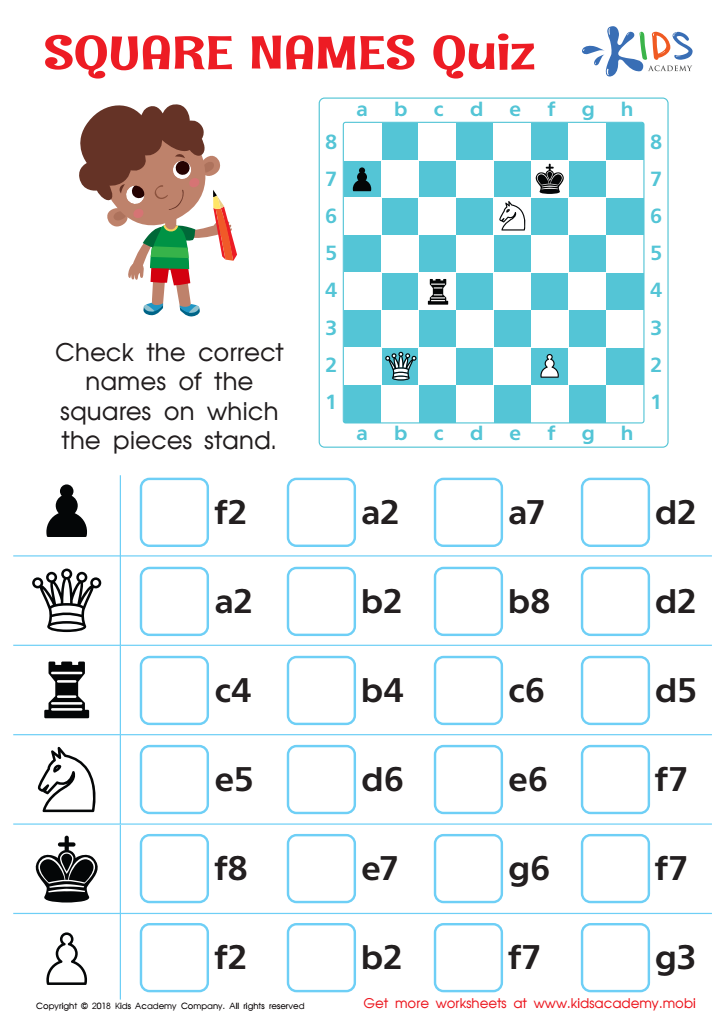
Make sure your students can identify the chess squares with ease! This free pdf worksheet will help them learn the names of the squares quickly and easily. Let them check the correct names of each square to prepare them for playing chess and making notations of their moves.
Square Names Quiz Worksheet
Worksheet
Names of Squares Worksheet

Names of Squares Worksheet

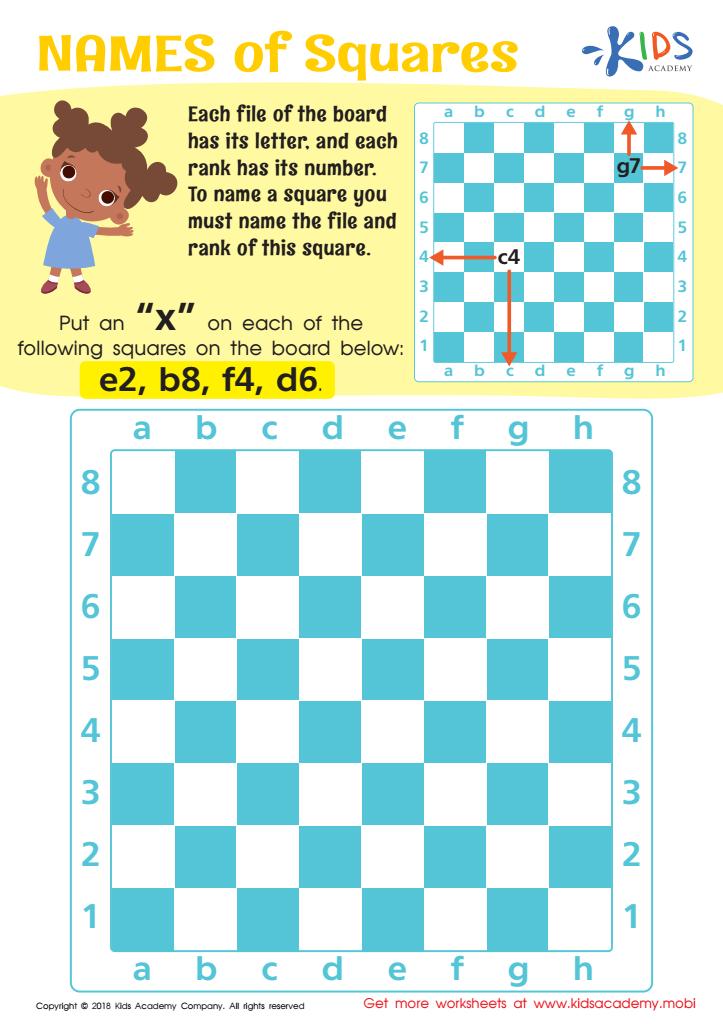
Ask your students to put an X on the appropriate squares. This worksheet is part of learning chess basics. Each file is marked with a letter and rank with a number. This allows moves and squares to be easily named and noted. e.g. The square marked "e5" is the fifth rank of the e-file.
Names of Squares Worksheet
Worksheet
En Passant Bingo Worksheet

En Passant Bingo Worksheet

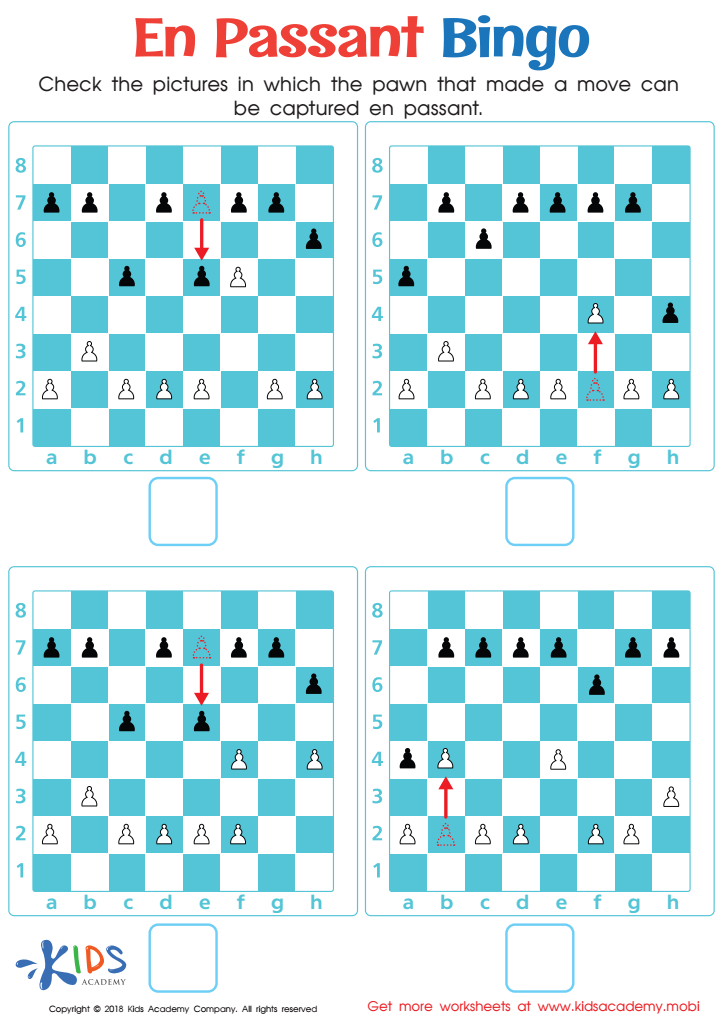
To teach kids to perfect the en passant move in chess, use this worksheet. It has pictures which depict when a pawn is in danger of being captured. By looking through the pictures, kids can easily understand and perfect the move.
En Passant Bingo Worksheet
Worksheet
Smart Capturing Worksheet

Smart Capturing Worksheet

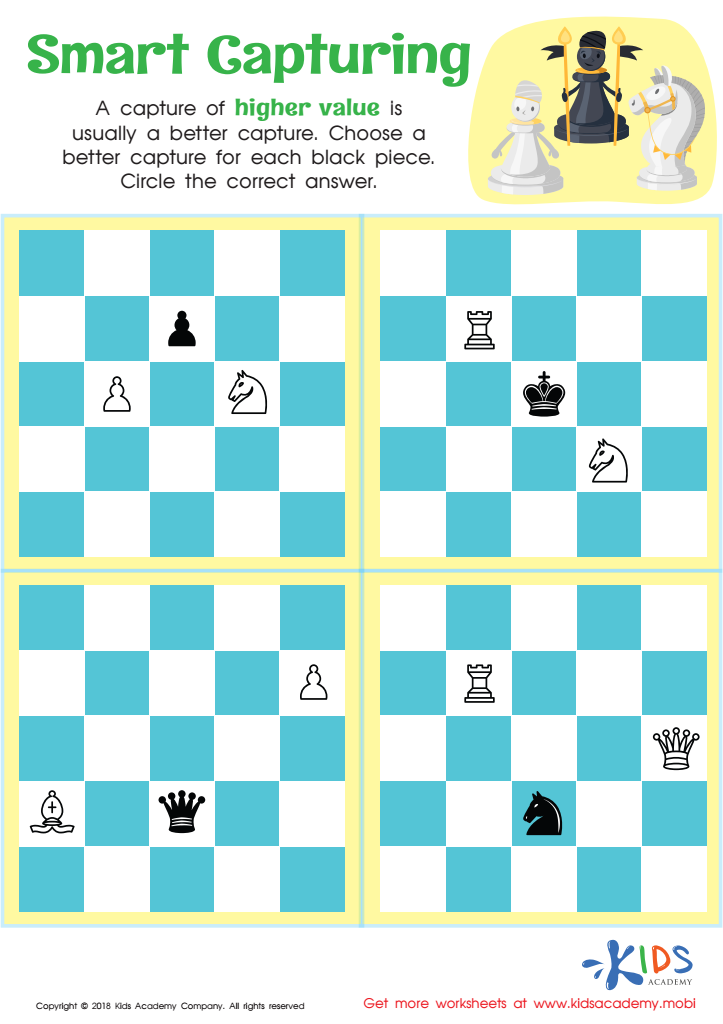
Chess is a game of strategy and calculation. When presented with two captures, a player should always go for the one that yields the highest value. For example, taking a knight over a pawn. In this worksheet, your children will choose the best capture for each black piece. Ask them to circle the correct answers. (80 words)
Smart Capturing Worksheet
Worksheet
Chess Pieces Math Worksheet

Chess Pieces Math Worksheet

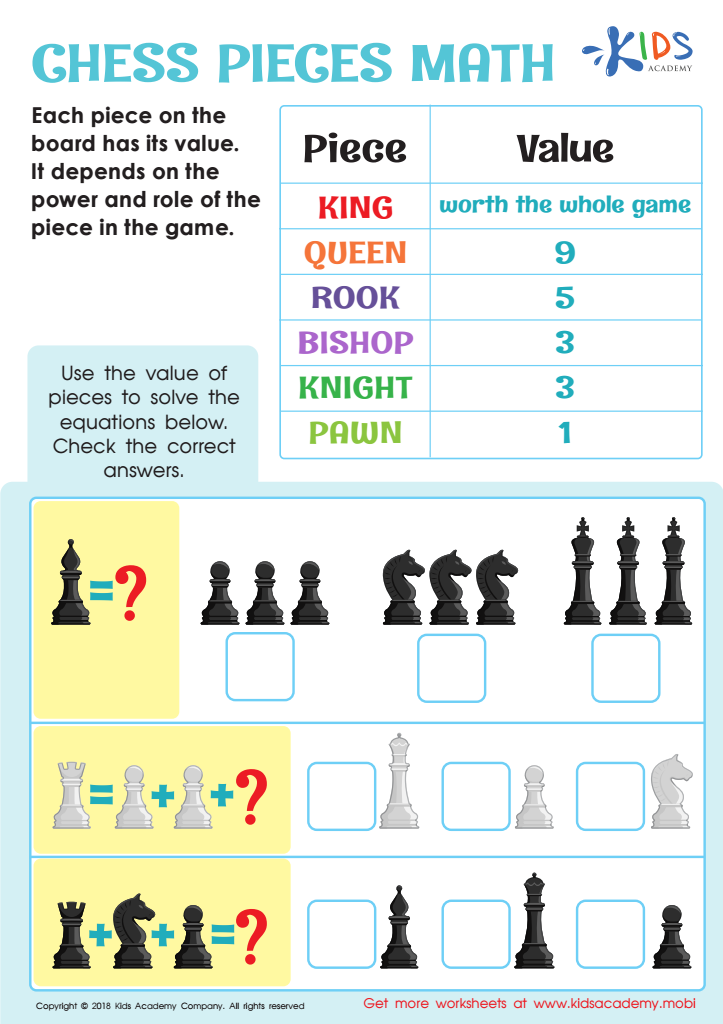
Chess involves math! Each piece has its own value, from the king (worth the entire game) to the queen (9 points), varying according to their power and role. In the worksheet, your child must use these values to solve the equations at the bottom.
Chess Pieces Math Worksheet
Worksheet
Changing Power of Chess Pieces Worksheet

Changing Power of Chess Pieces Worksheet

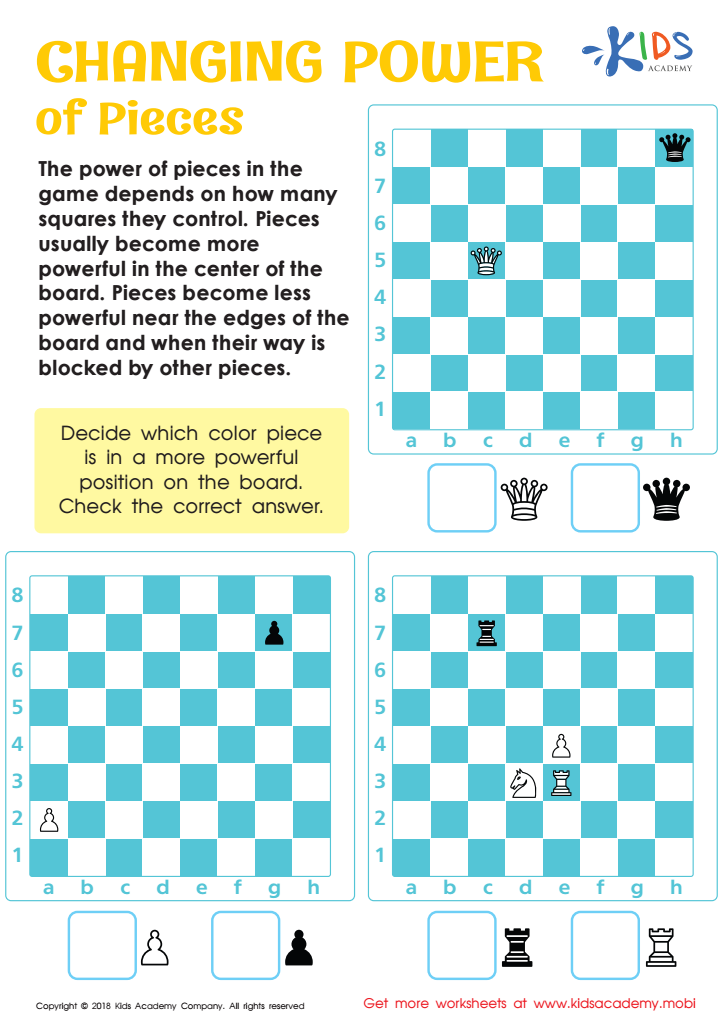
Chess pieces have different power levels based on their position. When in the middle of the board, they are strongest; at the edges or blocked by other pieces, they are weakest. Help your child learn which pieces are in powerful positions by examining the worksheet.
Changing Power of Chess Pieces Worksheet
Worksheet
Attacking Power of Chess Pieces Worksheet

Attacking Power of Chess Pieces Worksheet

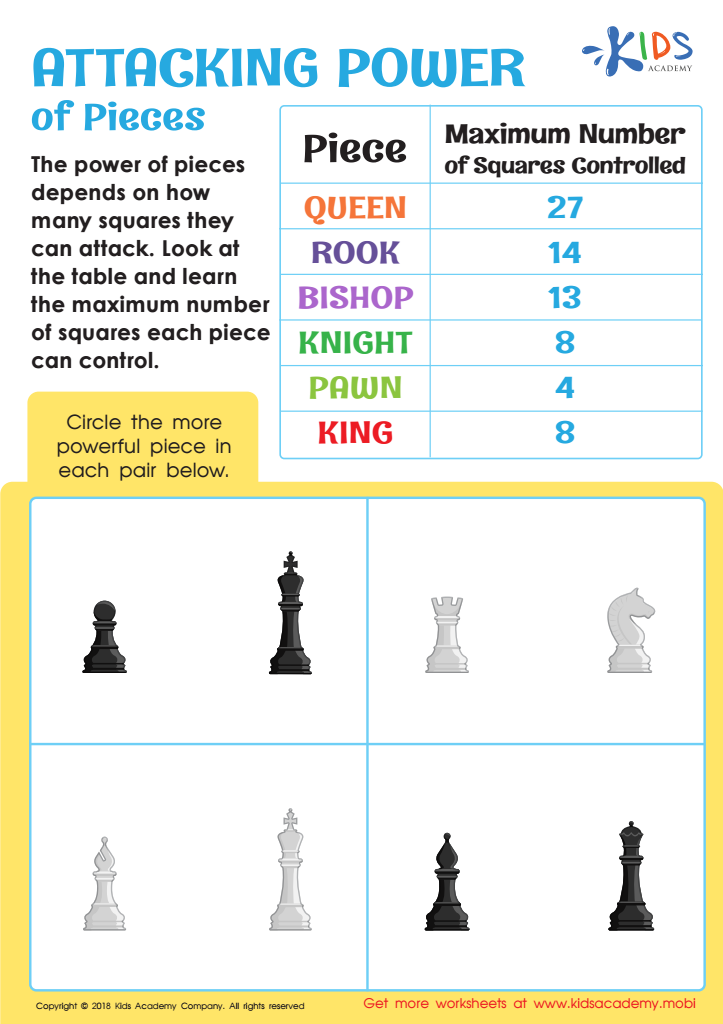
. This worksheet introduces your child to chess pieces and how they move. Ask them to look at the table, noting the squares each piece can control. Then, have them circle the most powerful piece among each power pictured at the bottom. With this insight, your child will gain an understanding of a chess piece's power and how many squares it can attack.
Attacking Power of Chess Pieces Worksheet
Worksheet
Writing it Down Worksheet

Writing it Down Worksheet

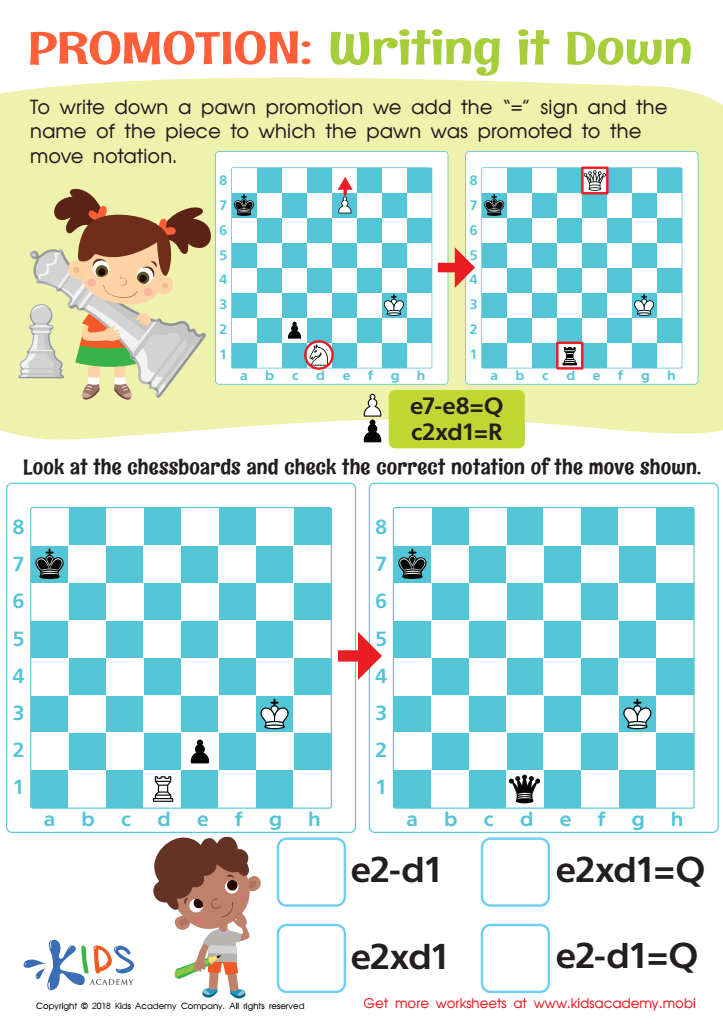
To document pawn promotion, add "=<piece name>" to the move notation. For example: e7-e8=Q. Ask your child to look at the chessboard and take note of the moves. Check the notations are correct. (80 words)
Writing it Down Worksheet
Worksheet
Promotion Practice Worksheet
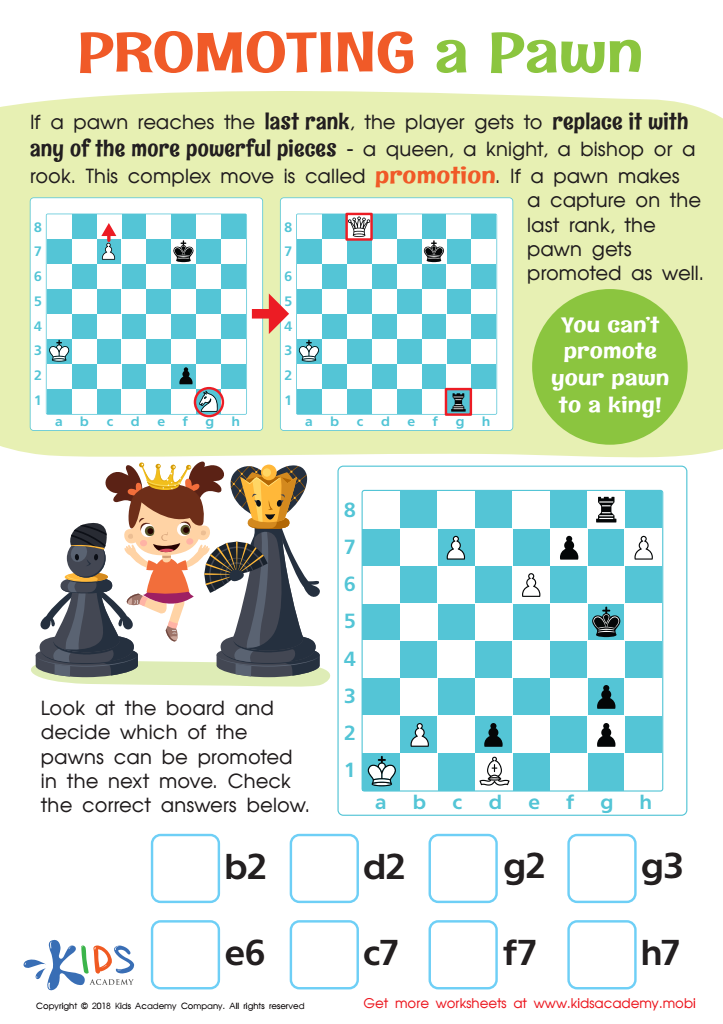

Promotion Practice Worksheet

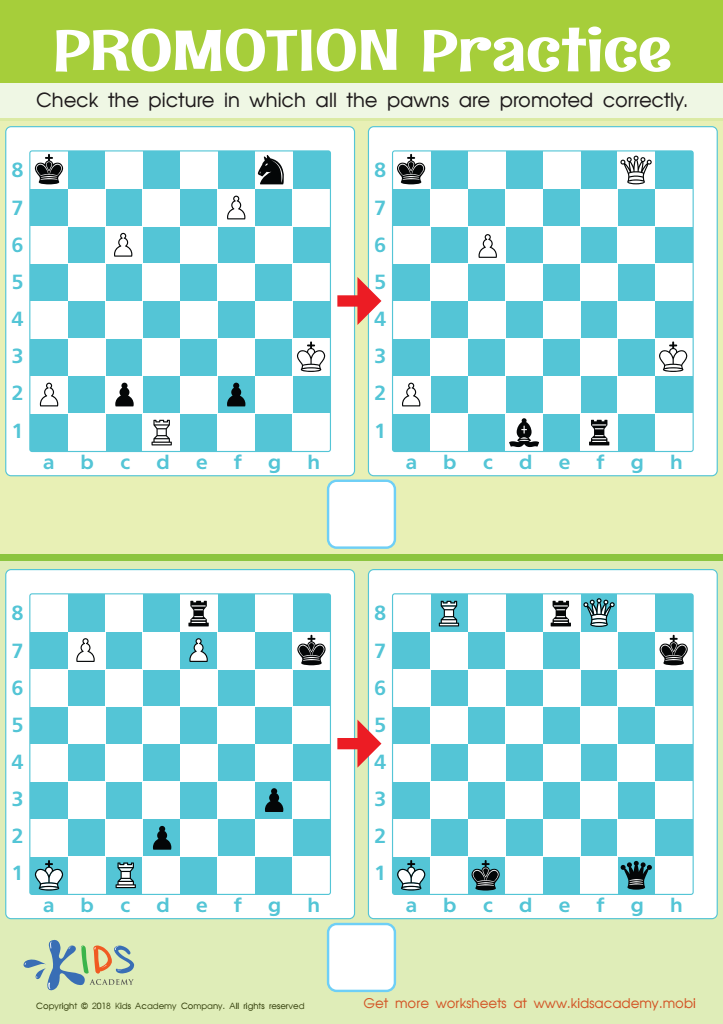
Test your kids' promotions skills with this worksheet! Ask them to find the pictures in which the pawns are correctly promoted. Remember, when a pawn reaches the last rank it may be promoted to a queen, bishop, knight or rook. In addition, a pawn can be promoted when it captures a chess piece on the last rank.
Promotion Practice Worksheet
Worksheet
Promoting a Pawn Worksheet

Promoting a Pawn Worksheet

Teach your kids all about pawns with this fun worksheet! Pawns may seem restricted, but experienced players can guide them across the board. If a pawn reaches the last rank, the player can upgrade it to a more powerful piece (e.g. queen, knight), or promote it if it captures an enemy piece. Give them the tools to master the game!
Promoting a Pawn Worksheet
Worksheet
Knight and Pawn Worksheet
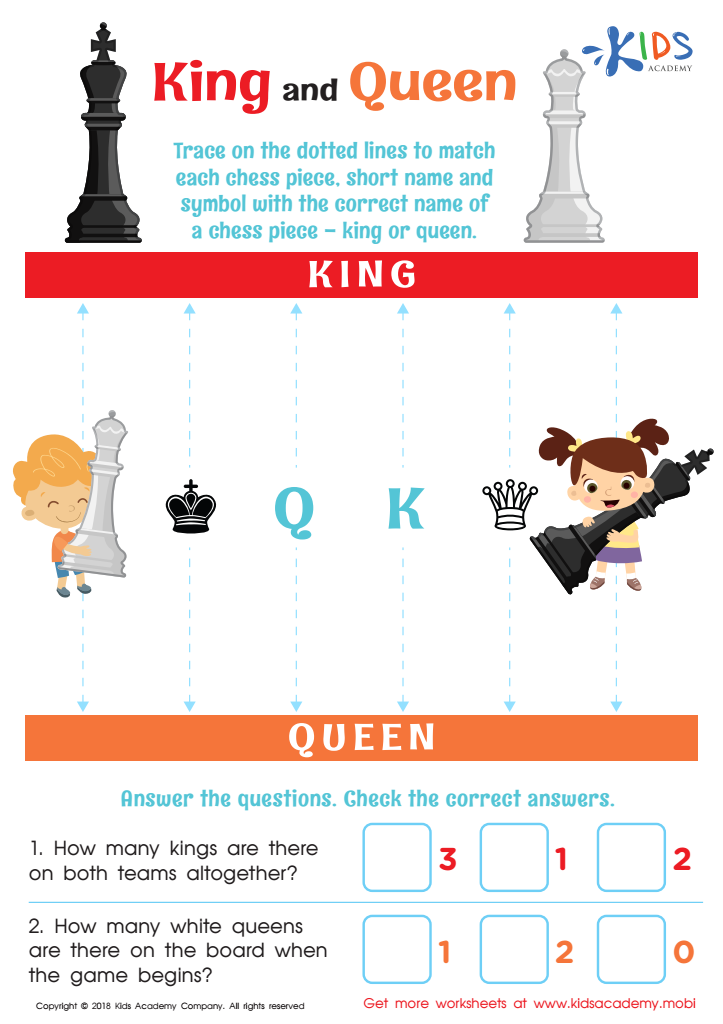
Knight and Pawn Worksheet

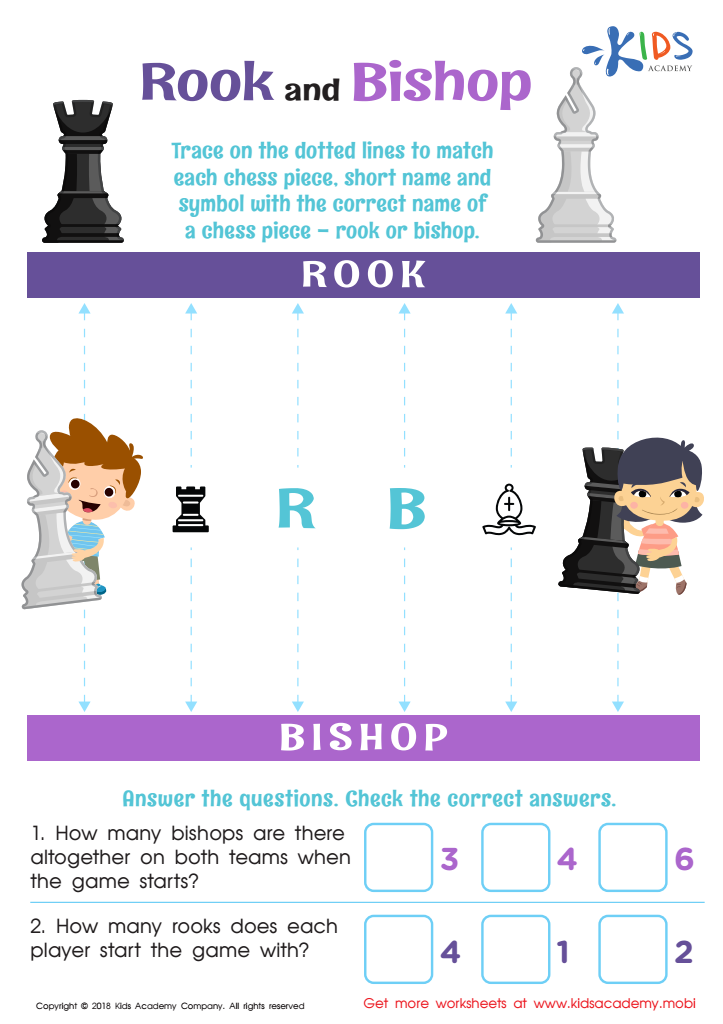
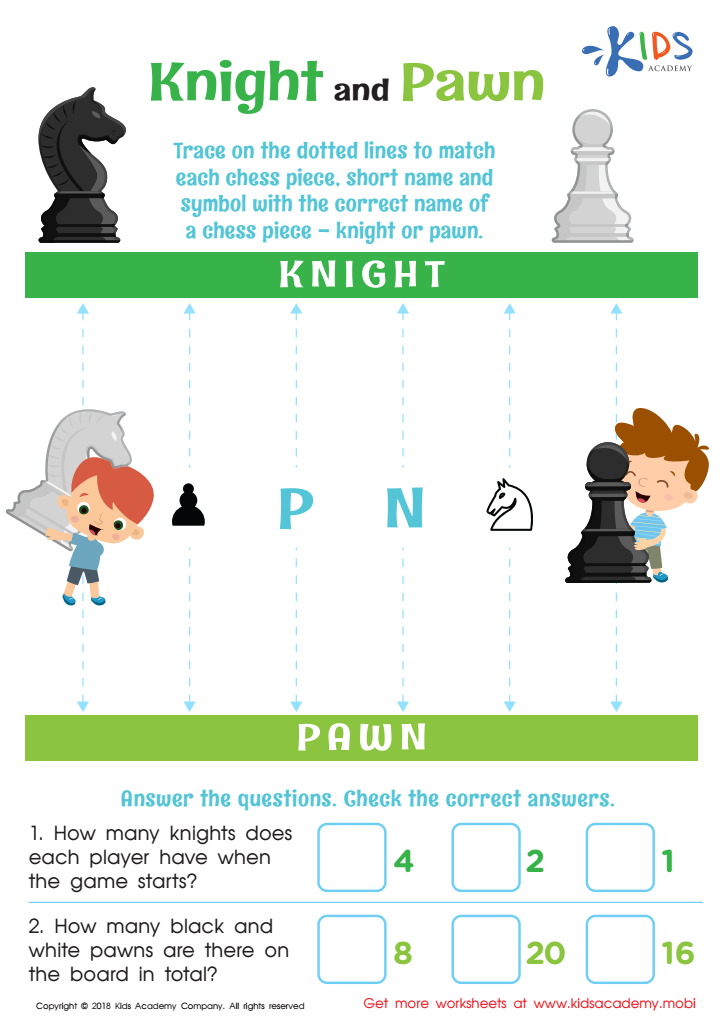
This tracing worksheet teaches kids about chess. They trace the dotted lines to match pieces, names and symbols to the correct chess piece. Questions at the bottom test their understanding. It's a simple exercise for a fun way to learn.
Knight and Pawn Worksheet
Worksheet
King and Queen Worksheet

King and Queen Worksheet

Instruct your kids to trace the dotted lines to match each chess piece, short name, and symbol with either king or queen.Answer the questions at the bottom and check the answers. This exercise will help your children to differentiate between a king and queen chess piece and know their symbols.
King and Queen Worksheet
Worksheet
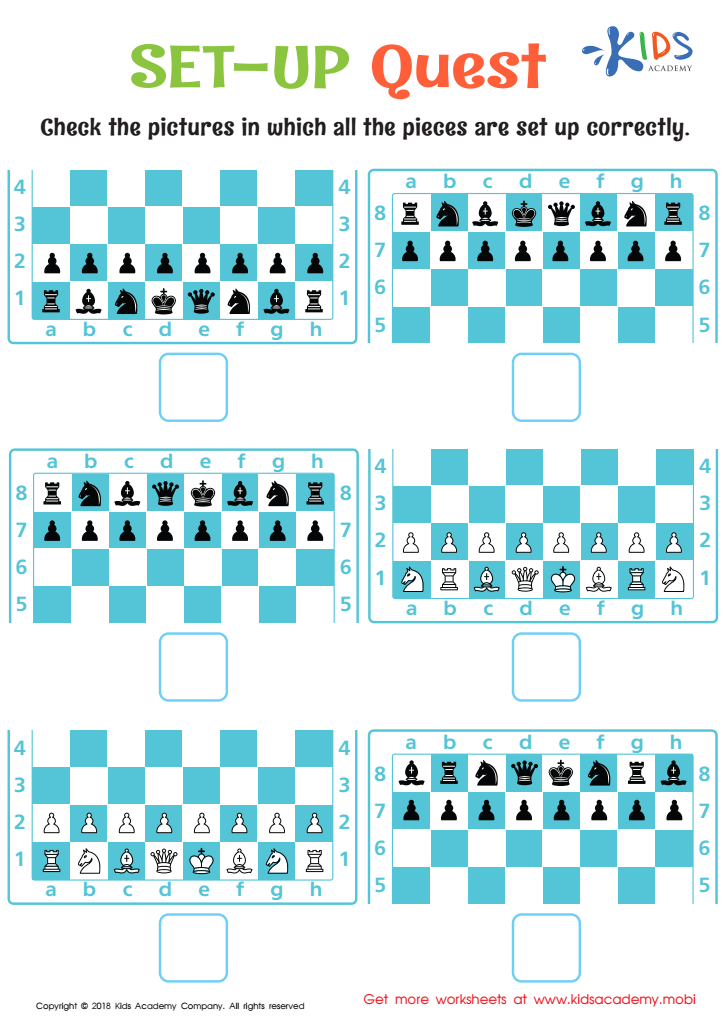
Set-up Quest Worksheet

Set-up Quest Worksheet

Have your students mastered checkmates? However, they may not know the proper way to set up a chessboard. Ask them if they know how and show them images of the correct set-up.
Set-up Quest Worksheet
Worksheet
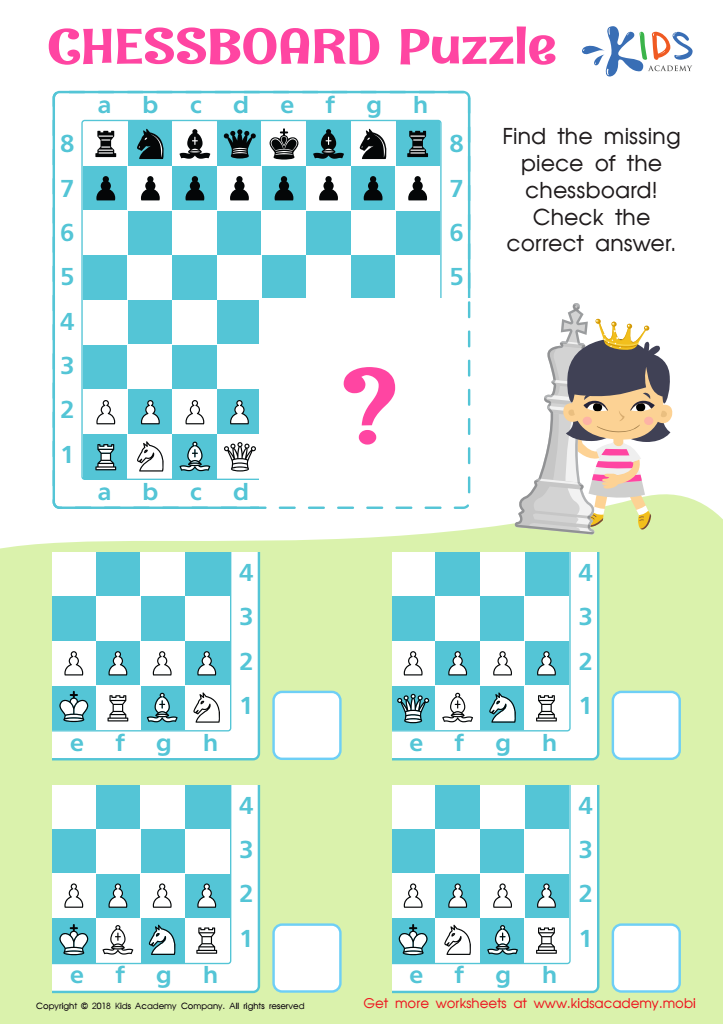
Chessboard Puzzle Worksheet
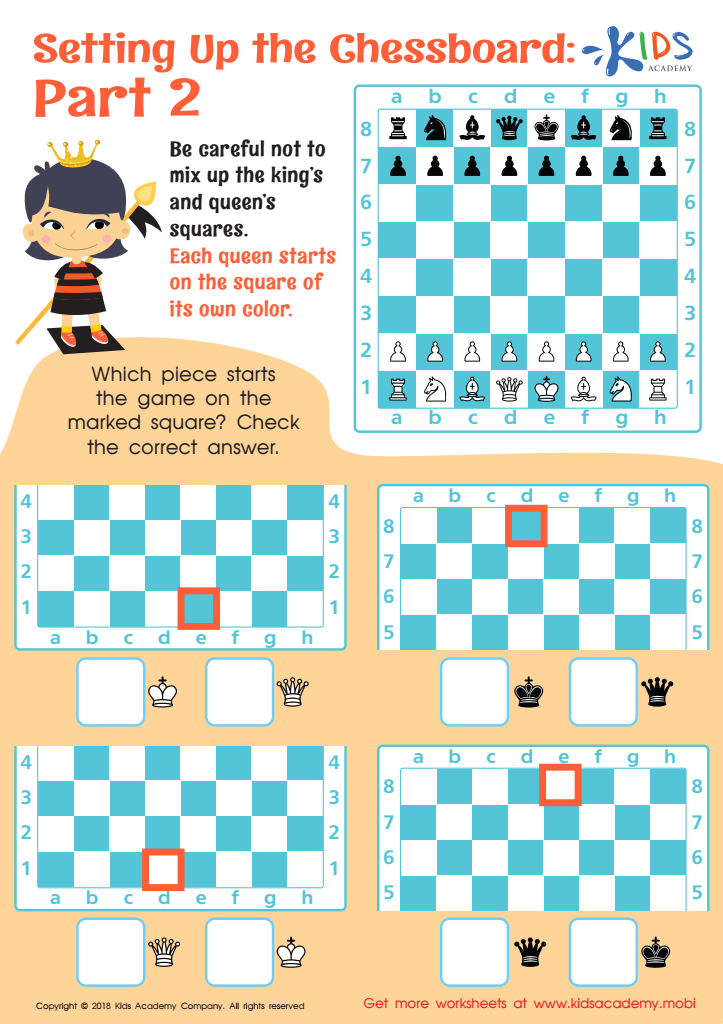

Chessboard Puzzle Worksheet

Test your child's chess prowess with this simple worksheet. They must find the missing pieces to complete the white side of an empty chessboard. The black pieces are already arranged properly on the board. Correct answers are provided so you can see how they did!
Chessboard Puzzle Worksheet
Worksheet
Setting up the Chessboard: Part 2 Worksheet
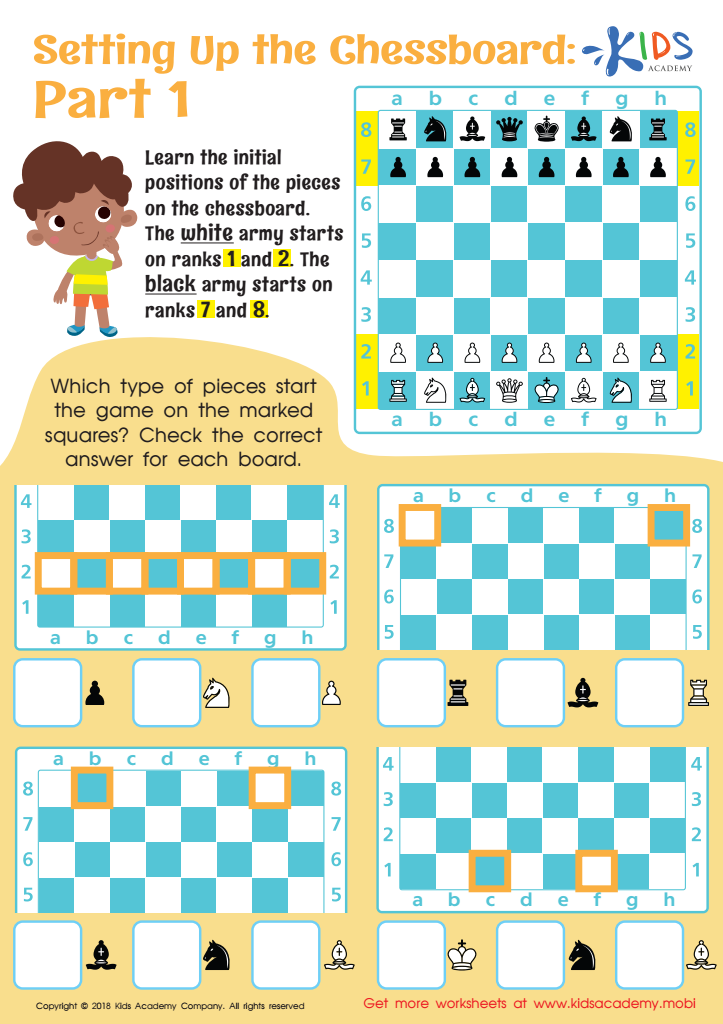

Setting up the Chessboard: Part 2 Worksheet

Before starting the game, make sure your child knows how to correctly set up the chessboard. Point to each square and ask them to name the piece that should be there. If they don't know, the printout can help. Remind them the queens should be on their own colour's square, then have them check the correct answers for the other pieces.
Setting up the Chessboard: Part 2 Worksheet
Worksheet
Setting up the Chessboard: Part 1 Worksheet

Setting up the Chessboard: Part 1 Worksheet

Teach your child the starting positions of the black and white armies on the chessboard. Black pieces are placed on ranks 7 and 8, and white pieces on ranks 1 and 2. Have them check the highlighted boxes on the chessboard to make sure they know the correct pieces to start with.
Setting up the Chessboard: Part 1 Worksheet
Worksheet
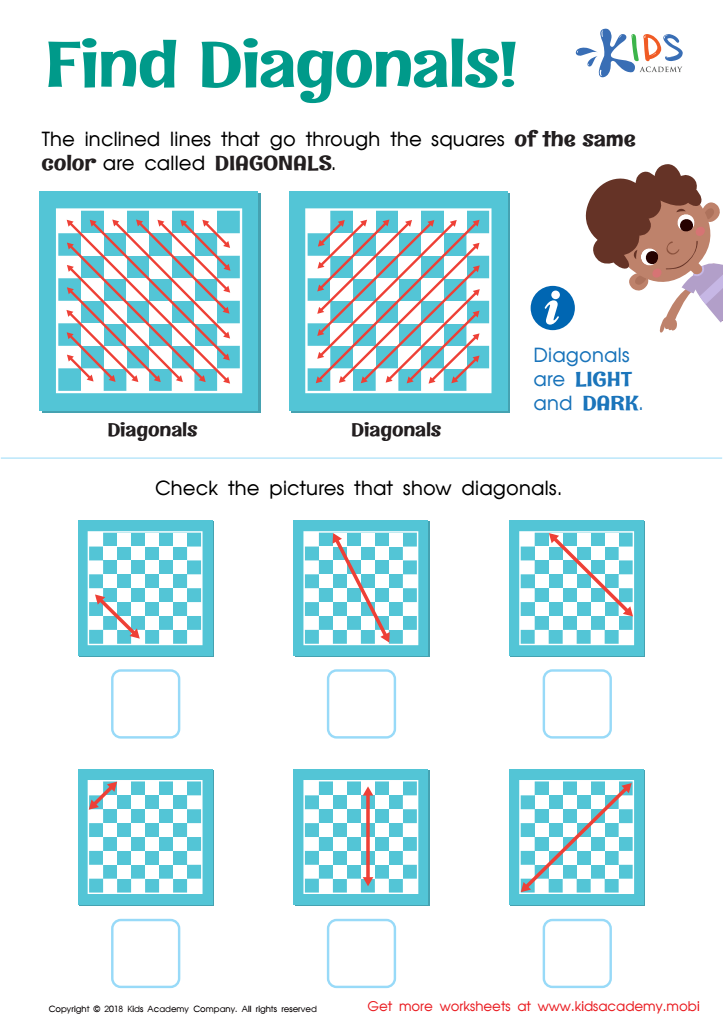
Find Diagonals Worksheet

Find Diagonals Worksheet

Help your child learn the name of the lines that go through squares with this fun worksheet. Diagonals slant in left or right directions and create the same shape. Ask your child to identify the pictures with correctly drawn diagonals.
Find Diagonals Worksheet
Worksheet
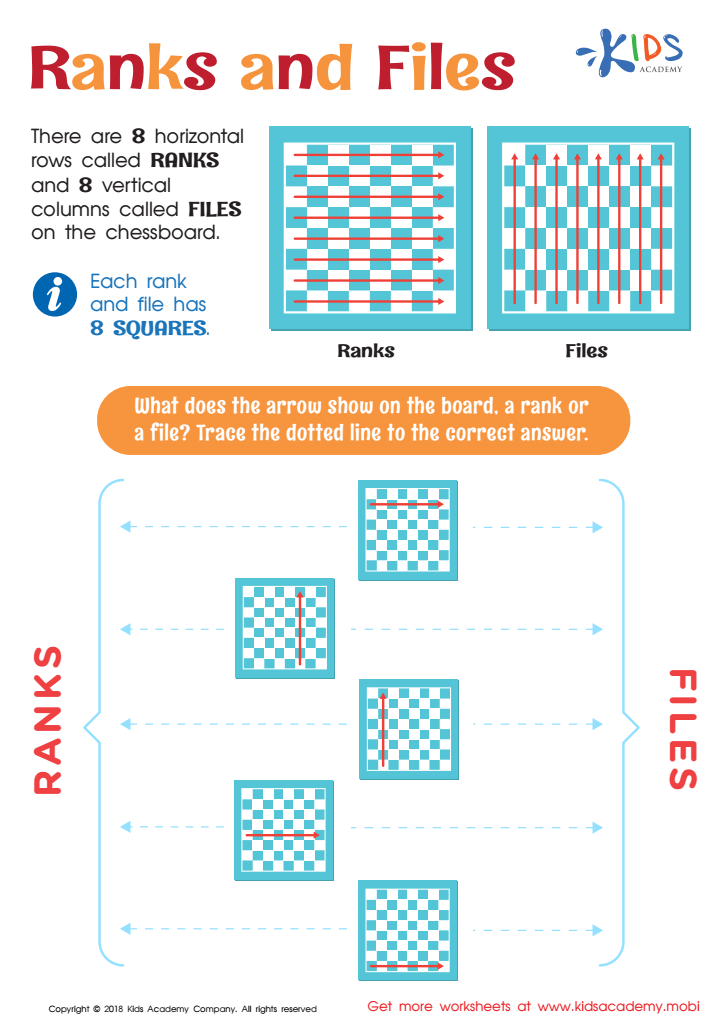
Ranks and Files Worksheet

Ranks and Files Worksheet

A chessboard has 8 horizontal ranks and 8 vertical files, each with 8 squares. Test your child's understanding of these directions with this fun worksheet!
Ranks and Files Worksheet
Worksheet
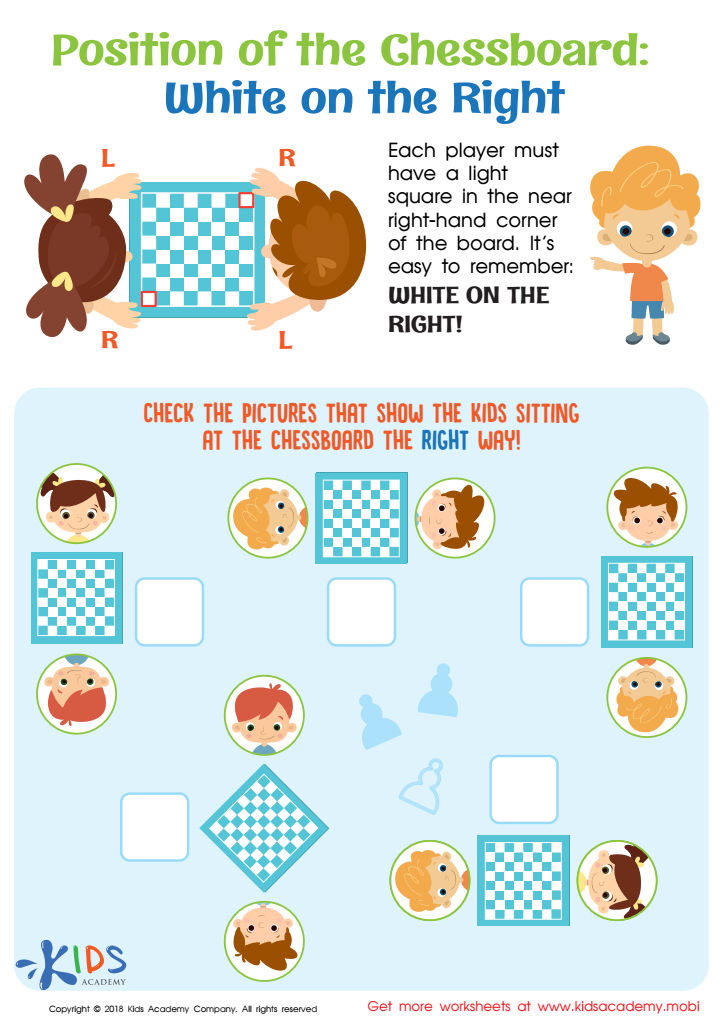
Position of the Chessboard: White on the Right Worksheet

Position of the Chessboard: White on the Right Worksheet

Proper positioning of the chessboard and players is key. Before the game, make sure the white square is in the right-hand corner. A simple rhyme can help: "White on the right". Check pictures of kids at the chessboard to ensure correct positioning.
Position of the Chessboard: White on the Right Worksheet
Worksheet
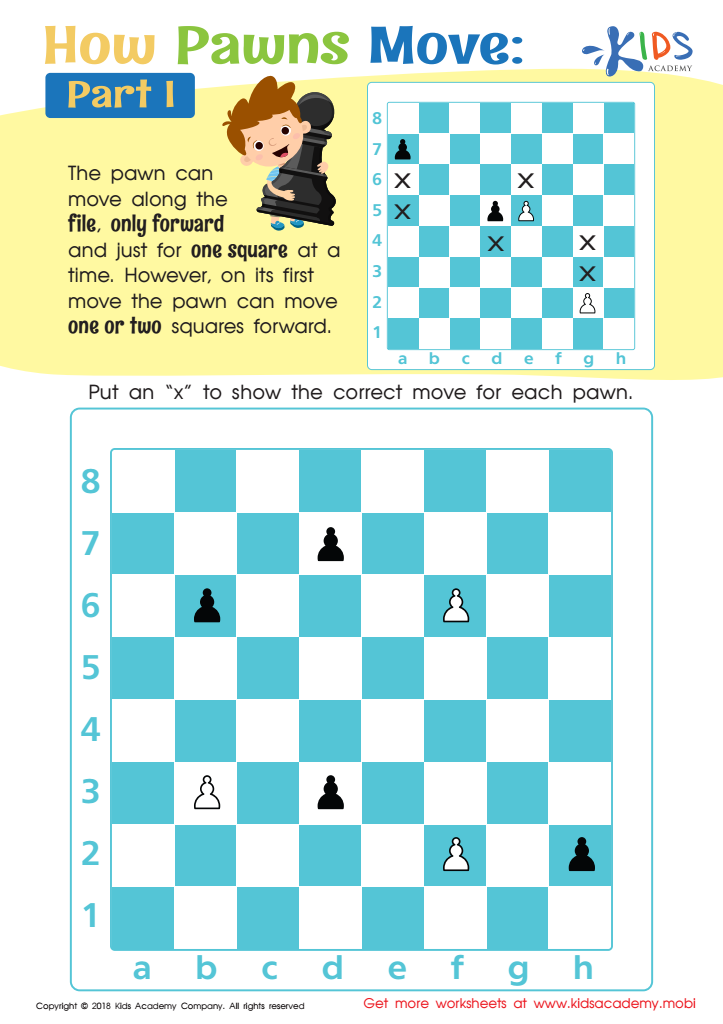
How Pawns Move: Part I Worksheet

How Pawns Move: Part I Worksheet

Pawns can only move forward along the file one square at a time. For its first move, a pawn can move one or two squares. Show your child how to move pawns by asking them to put an X for the correct move on this worksheet. This exercise will help them gain confidence in using pawns.
How Pawns Move: Part I Worksheet
Worksheet
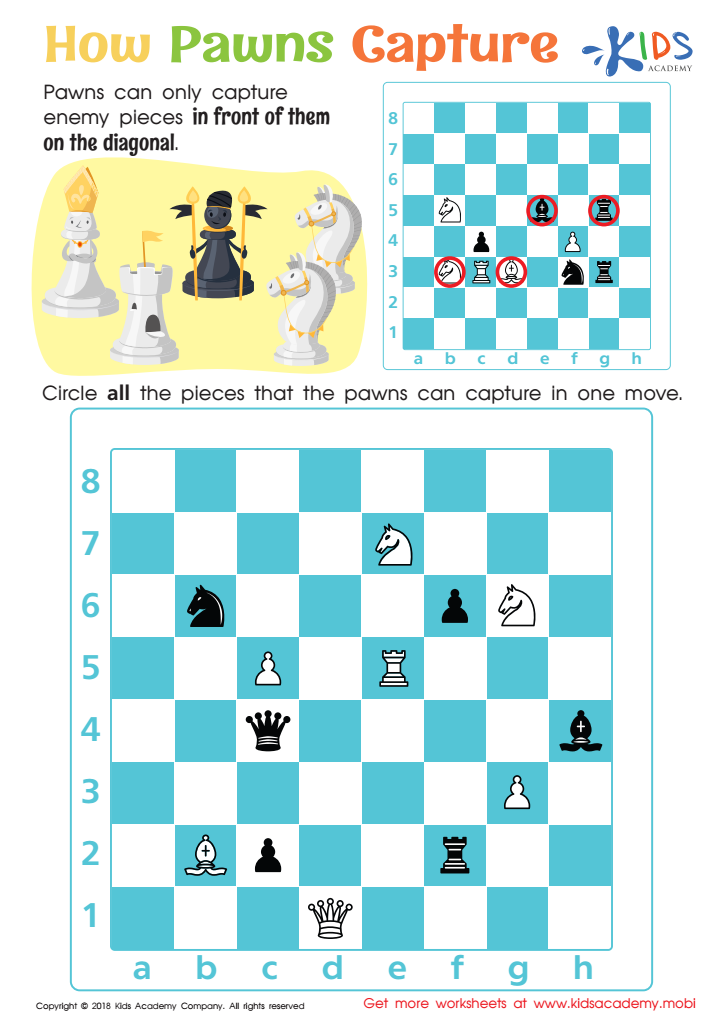
How Pawns Capture Worksheet

How Pawns Capture Worksheet

Ask your child to circle all the places a pawn can capture in one move on the diagonal. Pawns are limited in the moves they can make, but can still capture enemy pieces. This worksheet will help brush up on their knowledge of the rules of chess.
How Pawns Capture Worksheet
Worksheet
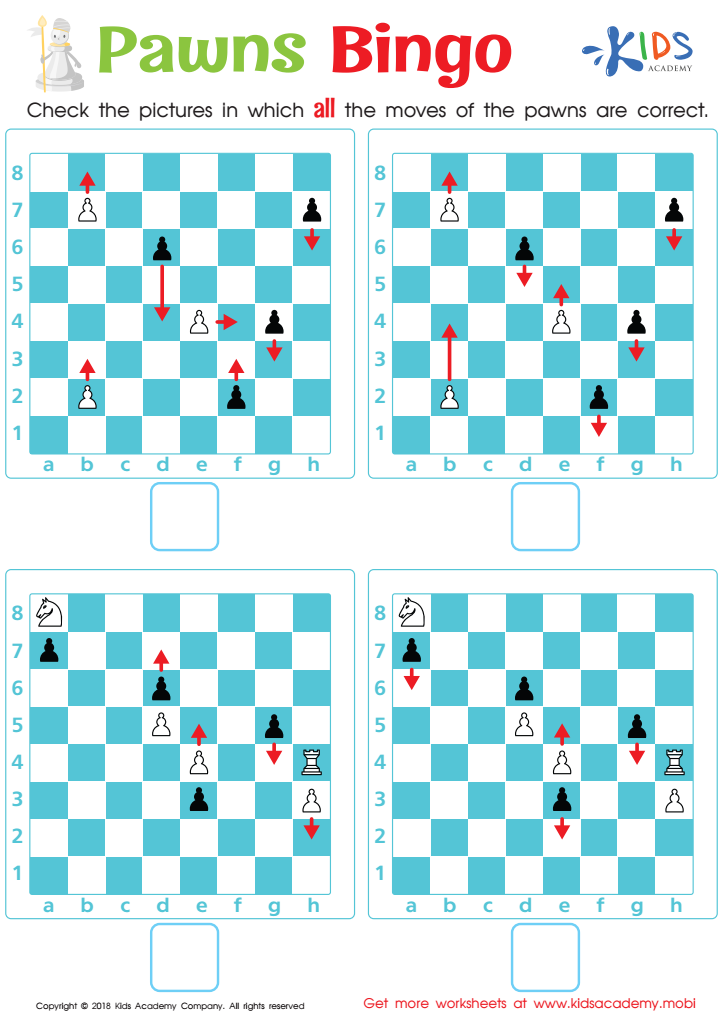
Pawns Bingo Worksheet

Pawns Bingo Worksheet

Test your students' knowledge of chess pawns. Present them with a worksheet featuring a picture, and ask them to identify the correct pawn moves. Afterward, they'll be better equipped to maneuver strategically on the chessboard.
Pawns Bingo Worksheet
Worksheet
How Pawns Move: Part II Worksheet


How Pawns Move: Part II Worksheet
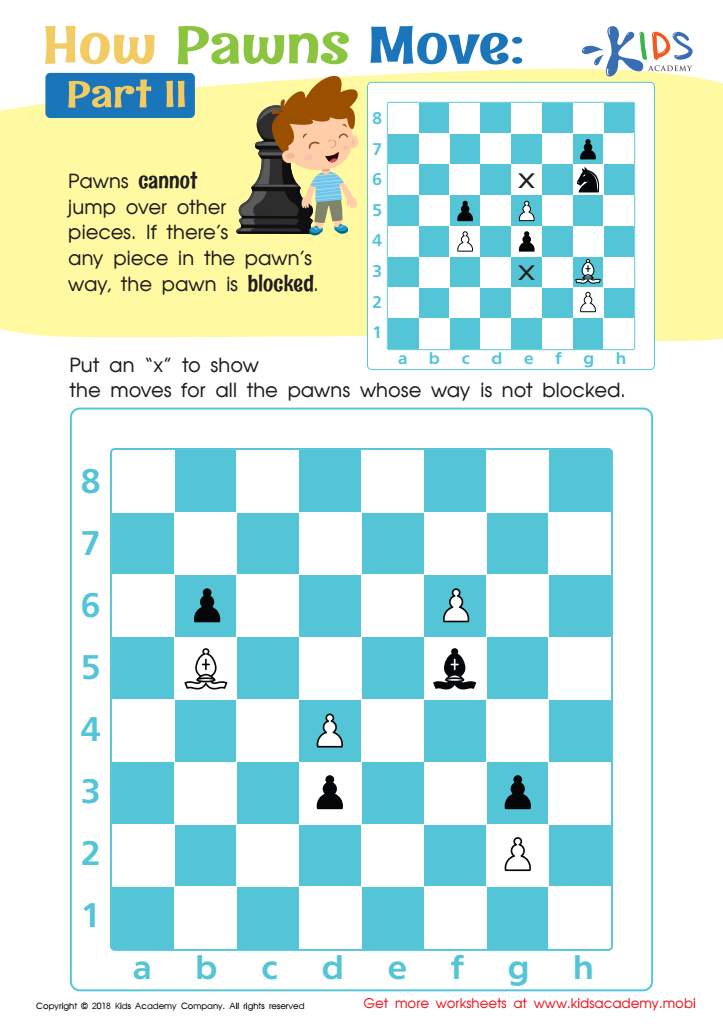
Pawns are the first to attack in chess and each player has the most pieces. They can't jump over other pieces, so if there's an obstacle, the pawn can't move. Ask your child to put an X to show all possible moves for the pawns not blocked by other pieces. (80)
How Pawns Move: Part II Worksheet

Worksheet
How King Moves Worksheet

How King Moves Worksheet

Teach your kids the fundamentals of chess with this worksheet! The goal is to checkmate the opponent's king, so it must be protected at all times. The king moves along files, ranks, and diagonals (except one square at a time), and cannot move to a square next to the enemy king. Your kids will soon master the art of checkmate!
How King Moves Worksheet
Worksheet


Normal worksheets for 7-Year-Olds serve as an essential tool in the educational journey of young learners. At this pivotal age, children are developing critical thinking, enhancing their reading and writing abilities, and starting to grasp more complex mathematical concepts. Normal worksheets are specifically designed to cater to the developmental stage of 7-year-olds, providing a balanced mix of challenges and achievable tasks that boost confidence and stimulate curiosity.

These worksheets are not only useful for reinforcing what is taught in the classroom but also for encouraging independent learning. By engaging with a variety of exercises, from simple arithmetic to basic science experiments, 7-year-olds can explore new ideas at their own pace. This autonomy in learning fosters a sense of responsibility and enhances problem-solving skills.

Moreover, normal worksheets for 7-Year-Olds are structured in a way that promotes attention to detail and improves concentration. Through consistent practice, children develop a disciplined approach to learning, laying a solid foundation for academic success in future years. Additionally, these worksheets often include fun and interactive elements, making learning an enjoyable experience and helping to instill a lifelong love for education.

In summary, normal worksheets for 7-Year-Olds are invaluable for nurturing young minds, equipping them with the skills and knowledge necessary for their ongoing educational journey.