Filters

12 filtered results

Clear all filters
Favorites
With answer key
Interactive

12 filtered results

Difficulty Level

Grade


Discover a world of learning with our engaging Elementary Phonics worksheets designed specifically for children ages 3-8! These activities introduce phonics in a fun and interactive way, helping young learners build essential reading skills. Our collection includes a variety of worksheets focused on letter recognition, sound blending, and word formation, ensuring that kids enjoy the process while mastering phonics concepts. Ideal for home or classroom use, these resources support early literacy development through creative exercises and vibrant visuals. Set your child on the path to reading success with our comprehensive phonics worksheets tailored to ignite curiosity and foster a love for learning!

Check out this FREE Elementary Phonics Trial Lesson for age 3-8!

Matching Initial Letter Sounds

Favorites
With answer key
Interactive
  • Elementary Phonics
  • 3-8
  • Interactive
Words: Assessment 4 Worksheet

Words: Assessment 4 Worksheet

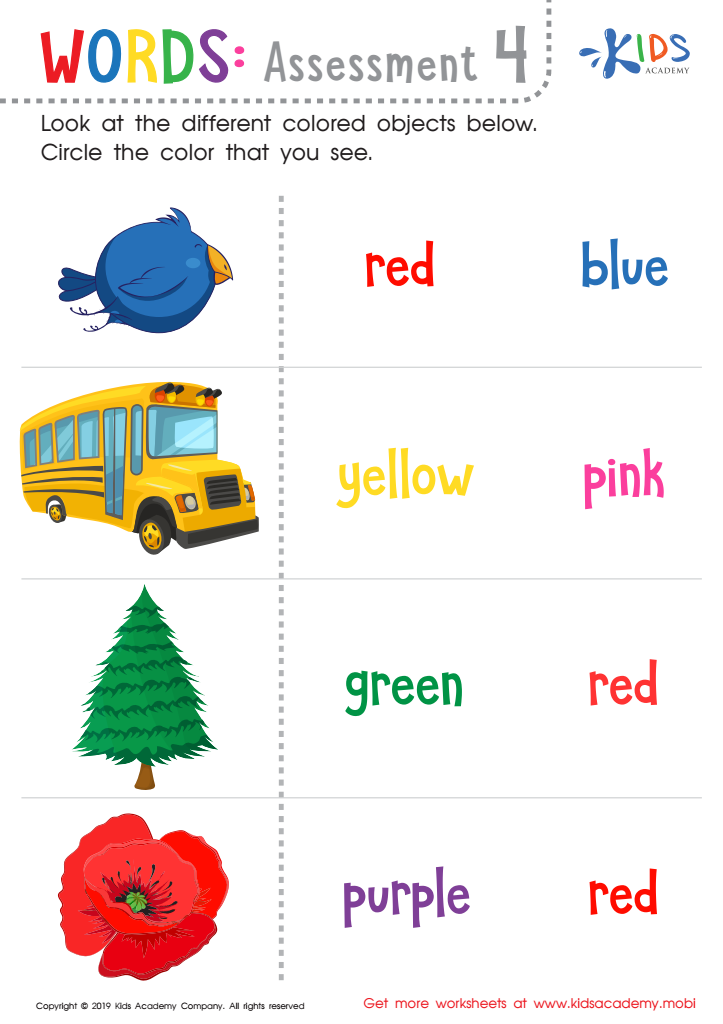
Look at the pictures and have your child circle the color they see. This free worksheet is great for assessing their knowledge of vocabulary words. It offers familiar images with words for kids to read and match with the colors. Help your child build their reading and understanding skills with this fun activity!
Words: Assessment 4 Worksheet
Worksheet
Words: Asessment 3 Worksheet

Words: Asessment 3 Worksheet

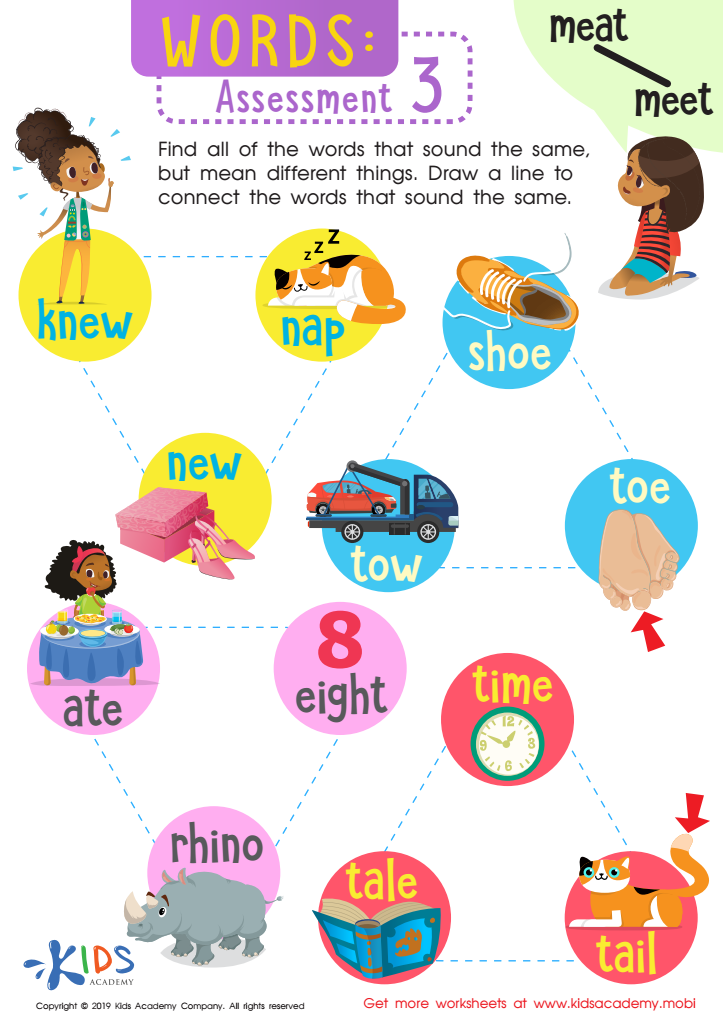
Assess your child's knowledge of homonyms with words like "toe" and "tow". This fun worksheet helps find words that sound the same but have different meanings and spellings. Use it to introduce homographs--words spelled the same with different meanings!
Words: Asessment 3 Worksheet
Worksheet
Words: Assessment 2 Worksheet

Words: Assessment 2 Worksheet

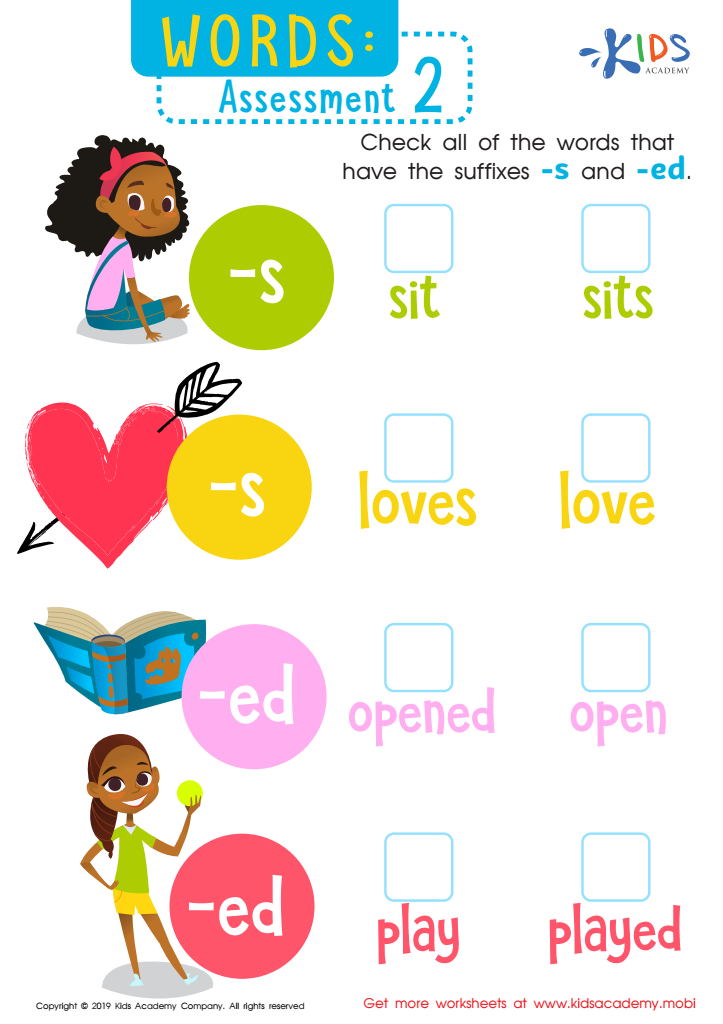
Test your child’s knowledge of -s and -ed word endings with this fun worksheet! They'll look at images and read the words, then choose the correct suffix to finish each one. Vivid illustrations make this an enjoyable learning experience!
Words: Assessment 2 Worksheet
Worksheet
Phonological Awareness: Assessment 3 ELA Worksheet

Phonological Awareness: Assessment 3 ELA Worksheet

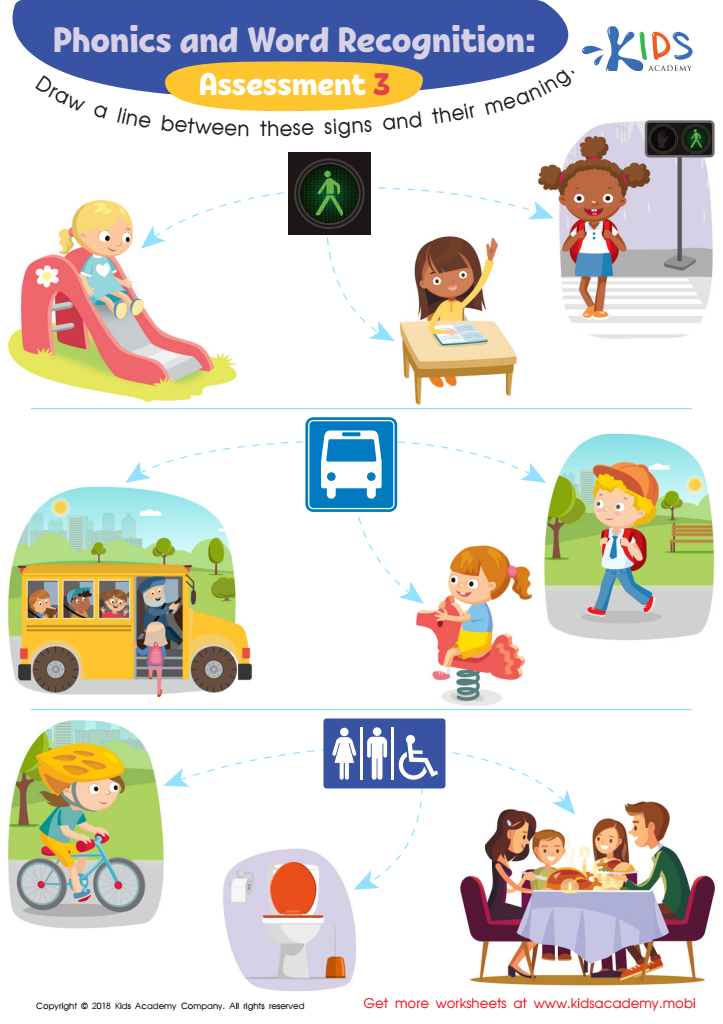
Want to test your preschooler's language skills, phonetic decoding and word recognition? This worksheet uses their knowledge of community helpers to match signs with depictions. It also works on fine motor skills, a key pre-reading skill.
Phonological Awareness: Assessment 3 ELA Worksheet
Worksheet
Phonological Awareness: Assessment 2 ELA Worksheet

Phonological Awareness: Assessment 2 ELA Worksheet

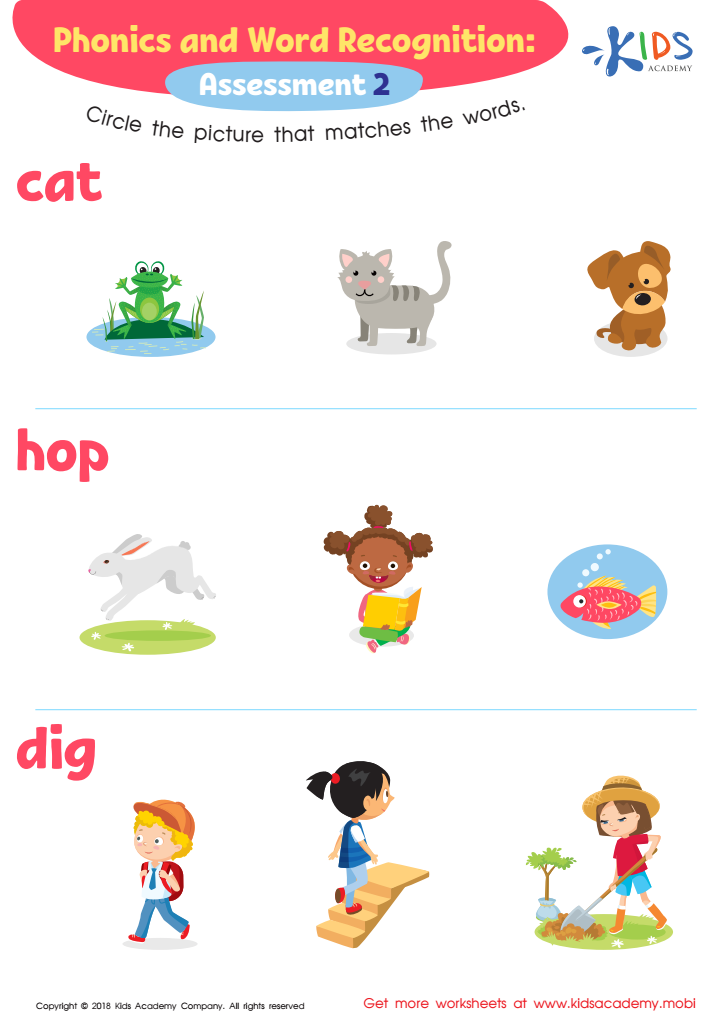
This free worksheet assesses your emerging reader's ability to decode and match closed-syllable high-frequency words to the appropriate picture. The pictures are cheery and easy to identify, so your child will have fun and find success with decoding and matching.
Phonological Awareness: Assessment 2 ELA Worksheet
Worksheet
Phonological Awareness: Assessment 6 Worksheet

Phonological Awareness: Assessment 6 Worksheet

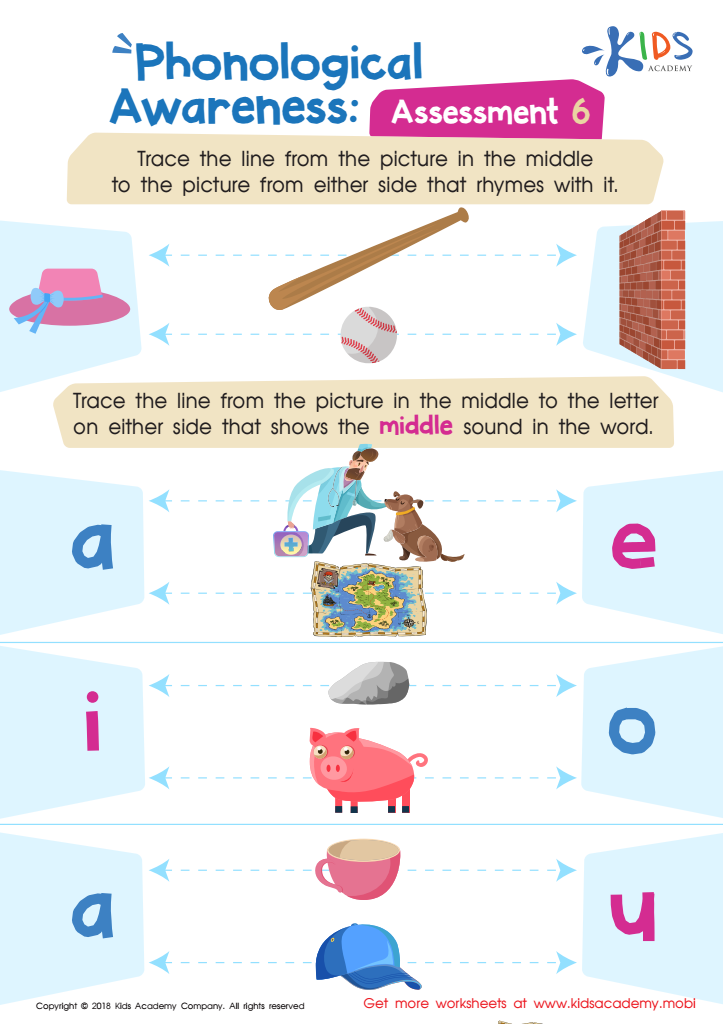
Check your child's ability to recognize middle word sounds using this free worksheet. Help them learn phonics by practicing with rhyming. Trace the line from the image to its rhyming match then encourage them to name each image aloud to identify which letter matches the sound. It's a great way to assess letter and sound recognition.
Phonological Awareness: Assessment 6 Worksheet
Worksheet
Phonological Awareness: Assessment 5 Worksheet

Phonological Awareness: Assessment 5 Worksheet

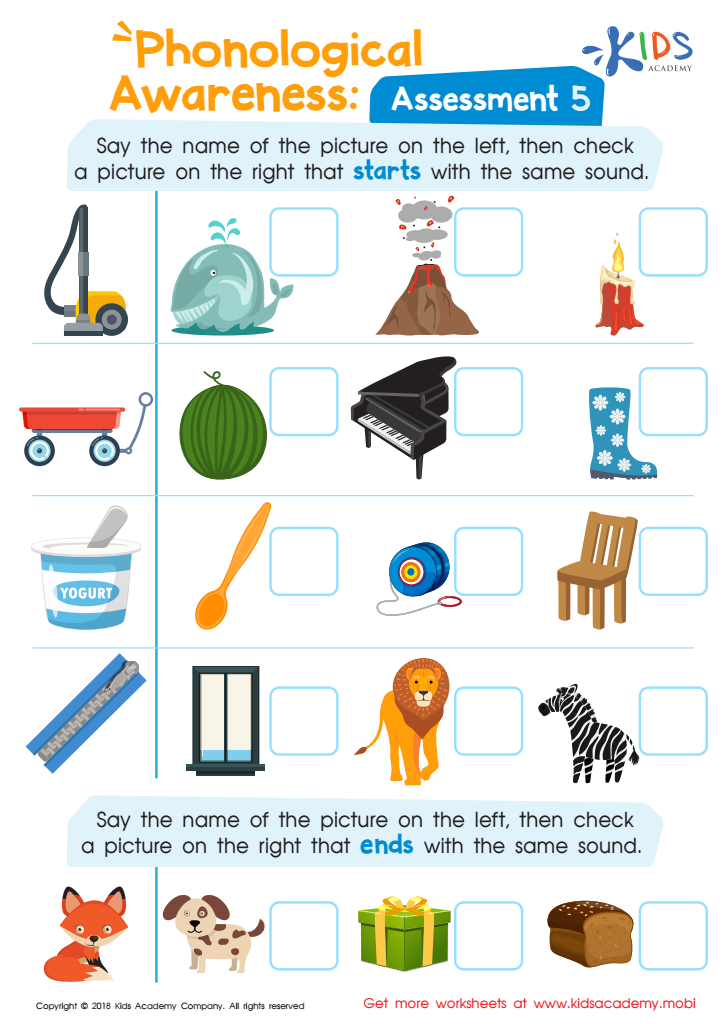
Repetition is key to success! This worksheet tests kids' ability to match beginning and ending sounds in words. Instruct them to say each word and listen closely to the sounds they make. Focus on the starting sounds for the first four pics, then the last one to hear ending sounds and find the right match!
Phonological Awareness: Assessment 5 Worksheet
Worksheet
Phonological Awareness: Assessment 4 Worksheet
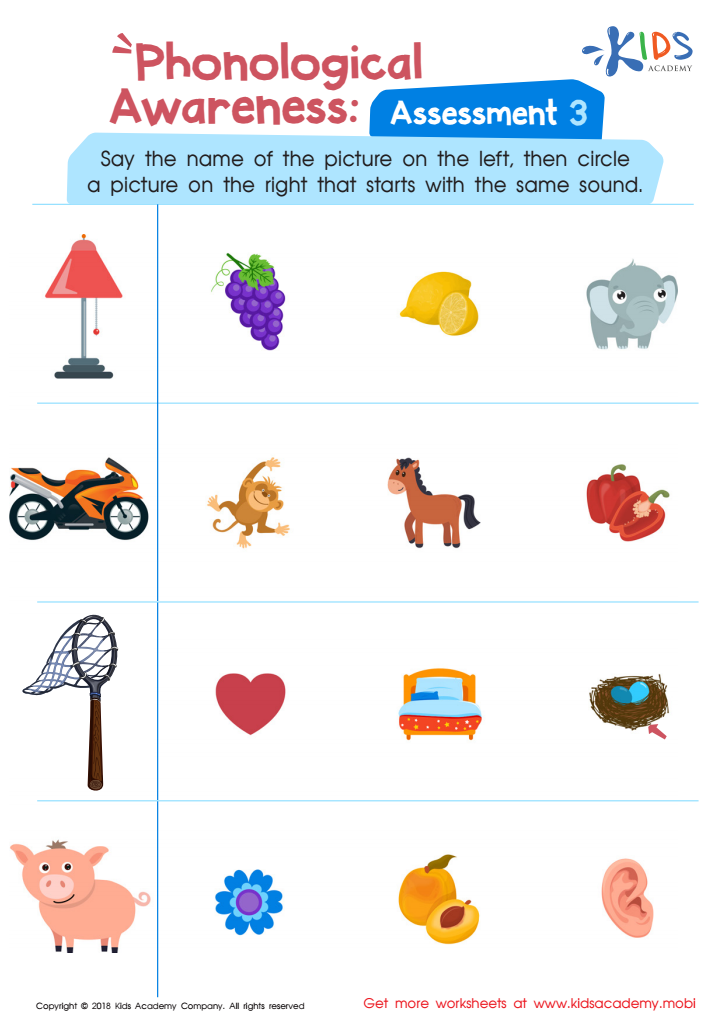

Phonological Awareness: Assessment 4 Worksheet

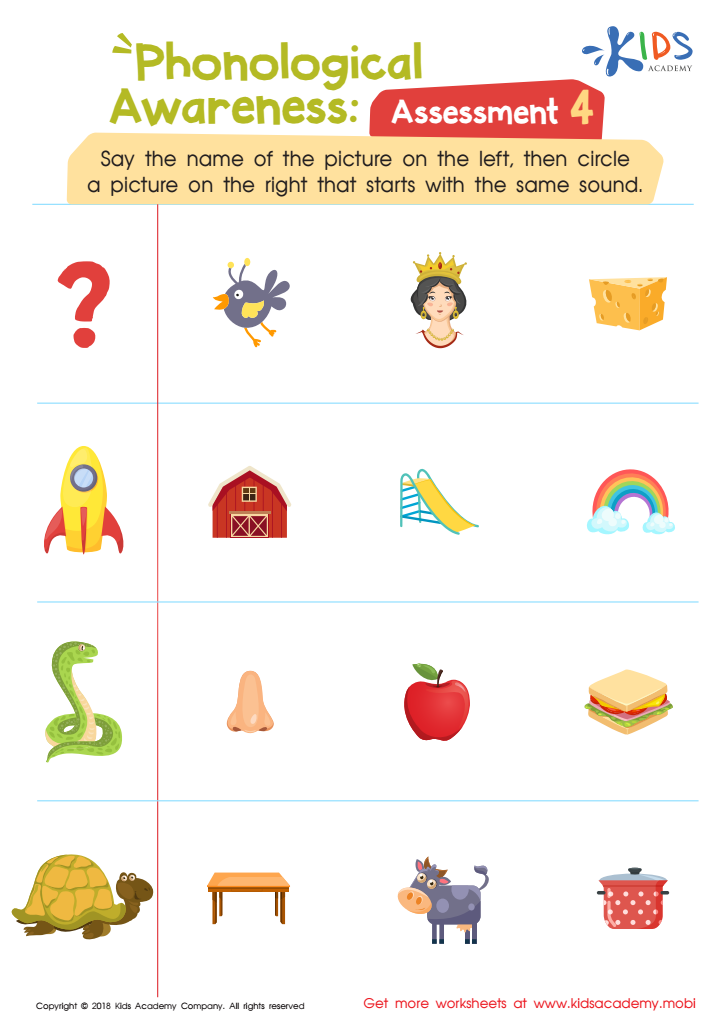
It can be tricky for young readers to differentiate between sounds in words. Make it fun with this downloadable worksheet! Ask your child to name each picture on the left and match the starting sound with an image on the right. This helps assess their phonics skills and make learning enjoyable.
Phonological Awareness: Assessment 4 Worksheet
Worksheet
Phonological Awareness: Assessment 3 Worksheet
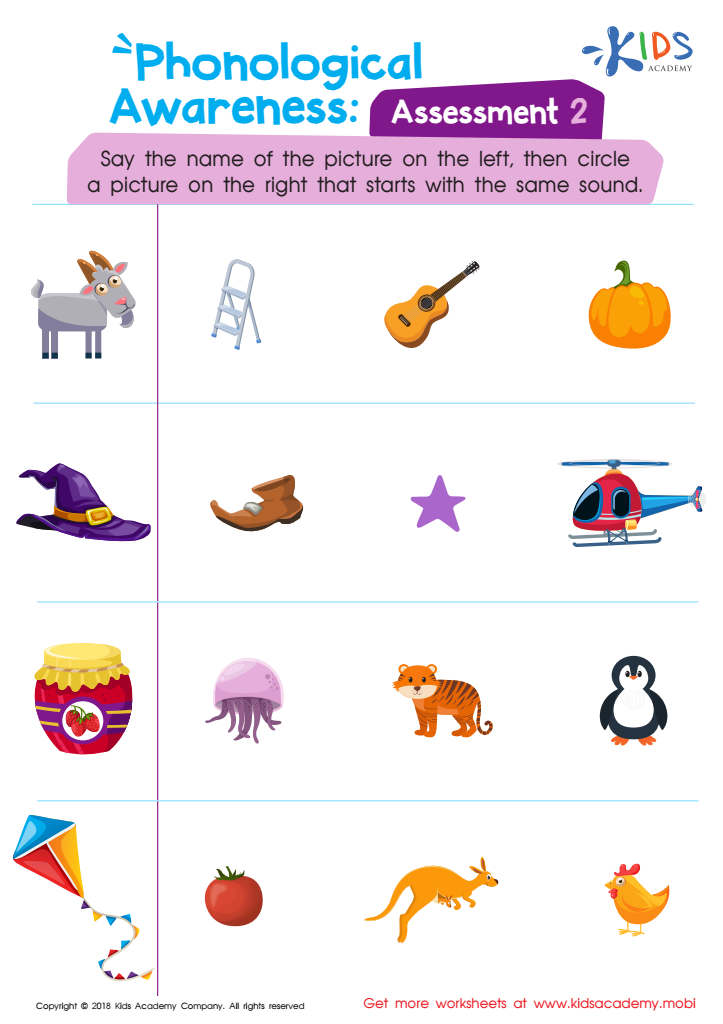

Phonological Awareness: Assessment 3 Worksheet

Test kids' reading readiness with a phonological awareness worksheet! With this PDF exercise, encourage children to name each picture aloud and match left to right. Help them learn to recognize word sounds at the start, middle and end of words. They'll be sure to remember that lamp doesn't sound like elephant!
Phonological Awareness: Assessment 3 Worksheet
Worksheet
Phonological Awareness: Assessment 2 Worksheet
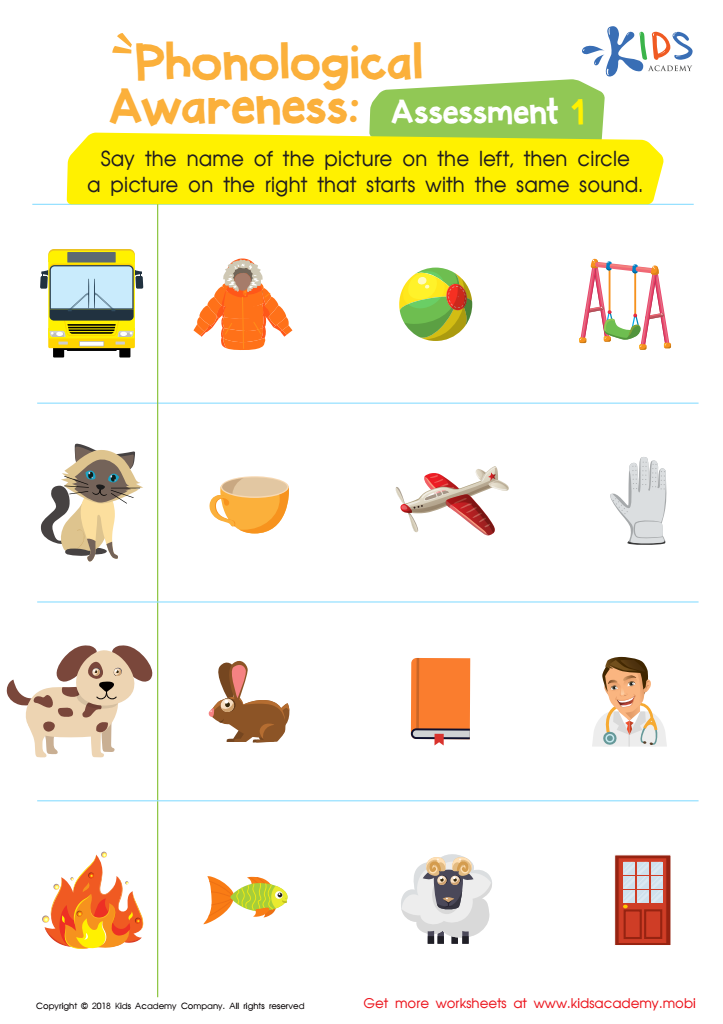

Phonological Awareness: Assessment 2 Worksheet

Test your child’s phonological awareness and reading readiness with this charming worksheet! Perfect for K-1, it assesses if they can name a picture aloud, listening for the starting sound and matching it to another word. Watch as they think deeply and listen to the sounds as they name each picture. Determine if your child is ready to sound out words or needs more phonics practice.
Phonological Awareness: Assessment 2 Worksheet
Worksheet
Phonological Awareness: Assessment 1 Worksheet
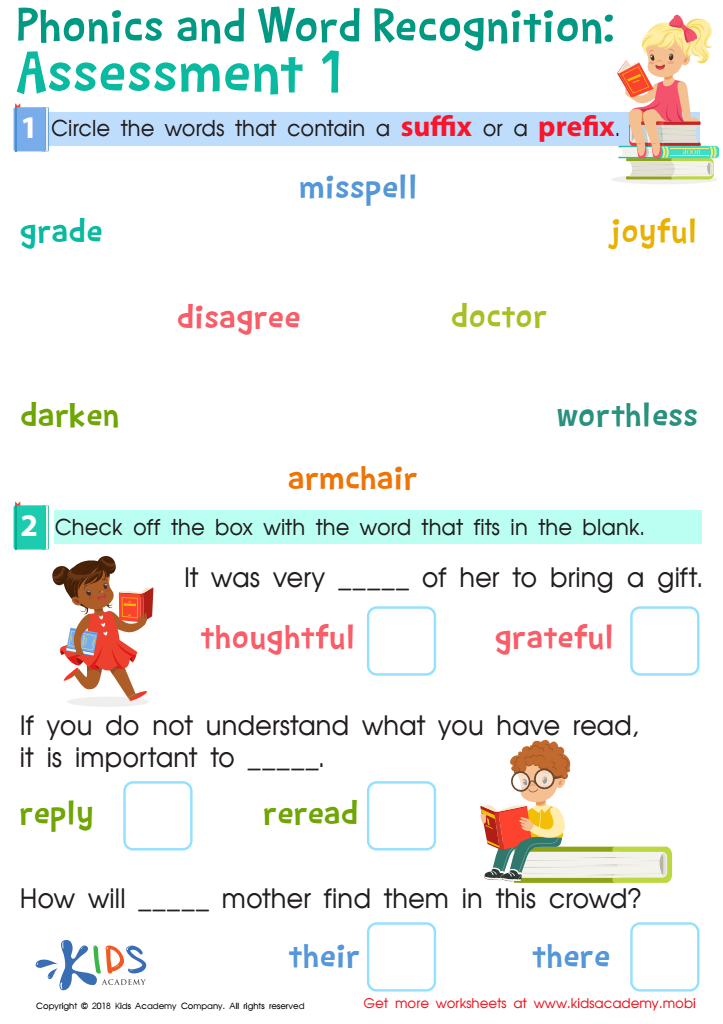

Phonological Awareness: Assessment 1 Worksheet

This worksheet helps kids build key phonics skills for pre-reading. They say each picture name aloud, focusing on the starting sound. Then, they match the sound with an image in the same row. Use as a checkpoint for kindergarten or grade 1 phonics readiness.
Phonological Awareness: Assessment 1 Worksheet
Worksheet
Phonics and Word Recognition: Assessment 1 Worksheet


Phonics and Word Recognition: Assessment 1 Worksheet

Explain prefixes (words added to start of another word to give it a new meaning) and suffixes (added to end of word to change its meaning) to your kids with examples like 'unhappy' (prefix) and 'forgetful' (suffix). Now, help your child complete this worksheet, including circling words and checking boxes.
Phonics and Word Recognition: Assessment 1 Worksheet

Worksheet


Elementary phonics activities are crucial for children aged 3-8 because they serve as the foundation for literacy development. At this critical developmental stage, children learn to connect sounds with letters, enabling them to decode words, read fluently, and ultimately comprehend text. Engaging in phonics activities not only helps improve children's reading skills but also boosts their confidence and motivation in learning.

Parents and teachers should care about phonics because early reading proficiency is linked to future academic success. Strong phonics knowledge sets the stage for future learning, impacting a child’s ability to grasp more complex reading and writing concepts later on. Additionally, phonics activities often promote language development through rhymes, songs, and games, making learning enjoyable and interactive.

Moreover, children who struggle with phonics may face significant challenges in school and beyond, leading to frustration and disengagement. Understanding phonics helps parents and educators support children who may be lagging, creating a more equitable learning environment.

By incorporating phonics activities into early education, parents and teachers can lay the groundwork for lifelong literacy and foster a love for reading, equipping children with essential skills for their academic journey and personal growth.